Shutterless Thermal Camera Module Comparison: 4 Cores
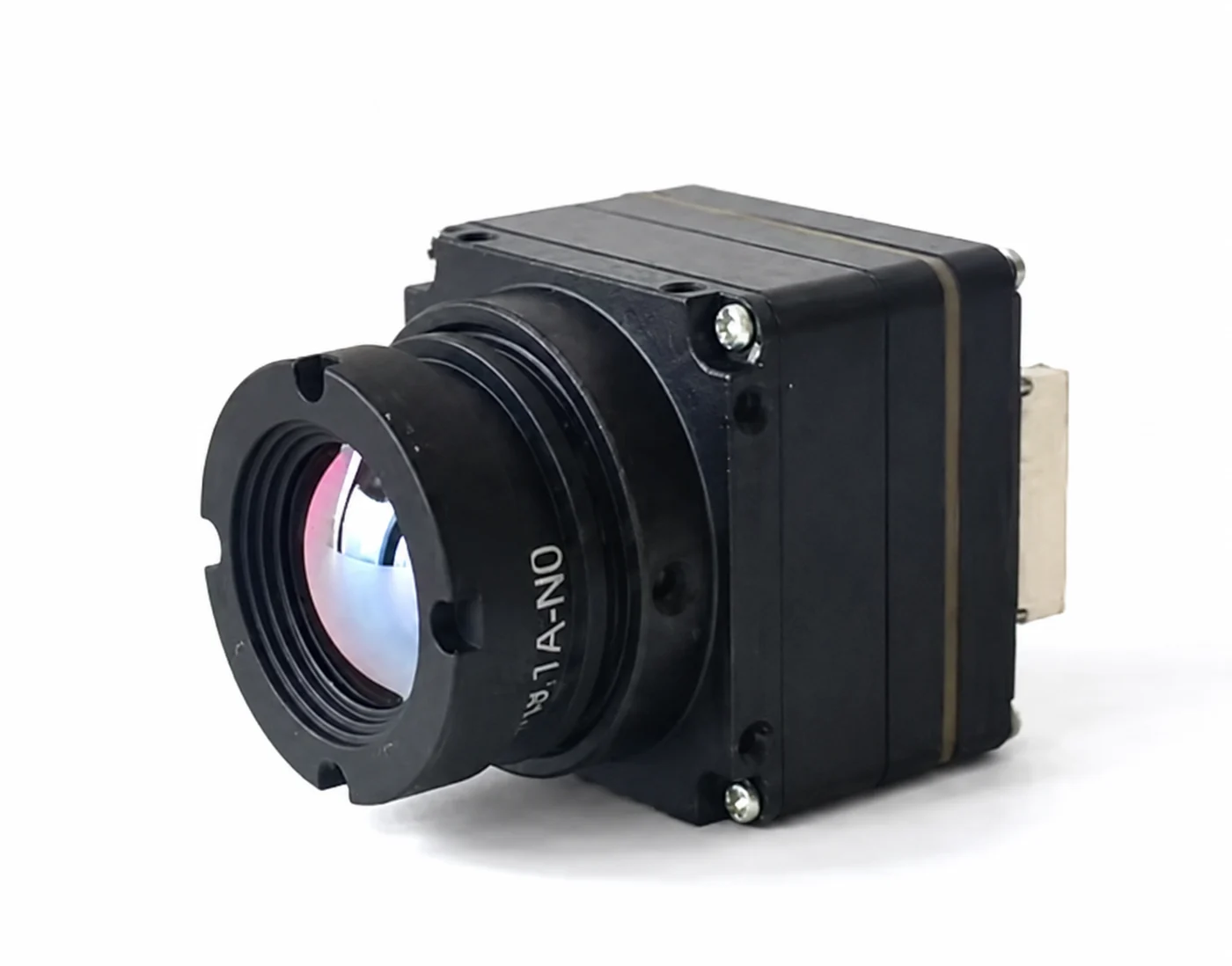
A shutterless thermal camera module comparison should separate mechanical correction, calibrated temperature measurement and fresh-frame delivery. This guide compares CAMCUDA HI640, FLIR Boson+ 23640X000, GSTiR iGS612 and iTherml MicroCor640+ using their published specifications, not bench benchmarks.
The four comparison entries are 640×512 uncooled LWIR cores. Their lens, board and test conditions differ, so the figures below do not establish a sensitivity, power or size winner. Leonardo DRS Tenum 640 Echo is an additional explanatory example: its 640×480 detector is not an equal-resolution comparison entry.
Shutterless correction is not the same as radiometry
Shutterless correction avoids inserting a mechanical flag into the imaging path during the specified correction process. It does not mean that non-uniformity correction (NUC) disappears. Pixel response differences and changes in detector operating conditions still need compensation. Scene content can affect image processing, but scene temperature should not simply be equated with detector thermal drift.
Three separate questions matter: how correction is performed, whether calibrated temperatures are available, and whether the complete system delivers fresh scene information. Radiometric conversion and compensation may be performed in the module or on the host. Either arrangement needs documented calibration, measurement range, accuracy and operating conditions.
16-bit transport data alone does not establish calibrated temperature output. HI640 transport bit depth is itself unconfirmed in the published materials. Image palettes, DDE and a NETD figure do not establish radiometry either.
NETD describes the noise level expressed as an equivalent temperature difference under stated test conditions. It is not absolute temperature accuracy or an unconditional minimum detectable temperature difference. Compare aperture, temperature conditions and product grade before interpreting different NETD figures.
The Tenum 640 Echo datasheet illustrates that shutterless operation can still involve an initial NUC. A 2018 Boson FFC note describes approximately 0.5 seconds of video freeze for that documented product and process. Neither behaviour should be transferred to current Boson+ configurations or HI640.
CAMCUDA HI640: published specification snapshot
The CAMCUDA HI640 640×512 Shutterless Uncooled LWIR USB Thermal Camera ModuleShutterless imaging lists shutterless NUC and USB, MIPI-CSI and CVBS video interfaces. Its 50 Hz value is the detector frame rate; supported USB capture rate and format require confirmation for the intended host.
| Field | HI640 specification |
|---|---|
| Detector | Uncooled VOx FPA, non-TEC; 640×512; 12 μm; 8–14 μm |
| Sensitivity and timing | NETD ≤40 mK at f/1.0, 300 K; 50 Hz detector frame rate; time to image <5 s |
| Power | DC 3.0–16 V, typical 5 V; <0.8 W; <1.2 W with USB |
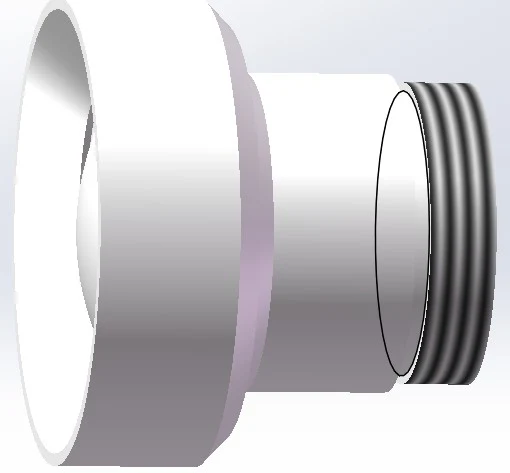
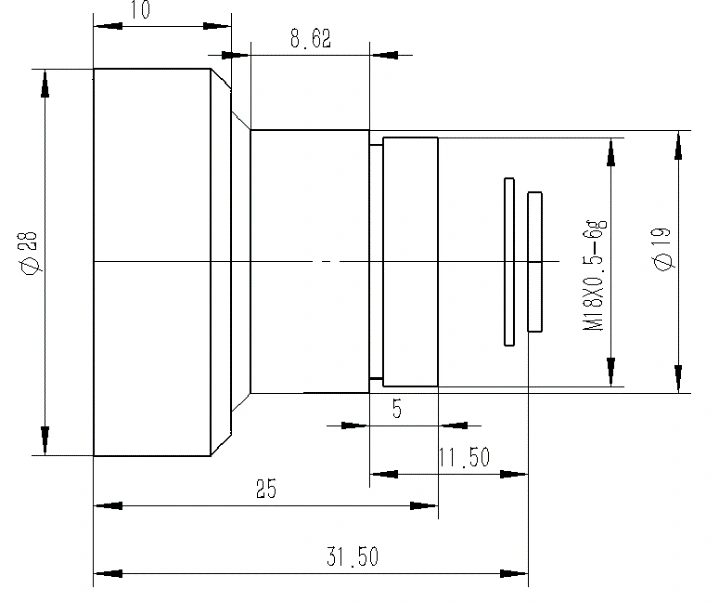
| Mechanical reference | PCB 21×21 mm; 4.8 mm lens reference assembly 21×21×41.5 mm (H×W×L) |
| Temperature ratings | Commercial operation −20 to +60°C; separate special-purpose entry −40 to +60°C; storage −45 to +65°C |
| Optics | 4.8, 6.8 and 9 mm options; published 4.8 mm FOV 78.5° H × 65° V; 6.8/9 mm FOV not published |
| Control and image functions | RS-232, five-button interface; DDE, 10 palettes, polarity/reversal/crosshair, auto/manual brightness/contrast; digital zoom 1–8× in 0.1× steps |
| Separate display entry | 768×576 / 50 Hz PAL; not detector pixel count or a guaranteed USB mode |
A commercial-unit order does not automatically include the special-purpose temperature rating. The 4.8 mm reference drawing does not establish the 6.8/9 mm assembly envelope. Digital zoom is electronic enlargement, not an optical zoom lens.
Shutterless thermal camera module comparison: four configurations
Published specifications reviewed . The configuration scope is part of every comparison: bare-core dimensions, lens assemblies and optional boards are not interchangeable measurements.
| Field | CAMCUDA HI640 Shutterless imaging | FLIR Boson+ 23640X000 | GSTiR iGS612 | iTherml MicroCor640+ |
|---|---|---|---|---|
| Configuration scope | PCB and specified 4.8 mm lens assembly reference | Selected lensless/shutterless SKU 23640X000; confirm order grade | Bare core; extension components separate | Core without lens/cover; optional or expansion boards separate |
| Detector / spectral band | 640×512 VOx, 12 μm; 8–14 μm | 640×512 VOx, 12 μm; 8–14 μm | 640×512 VOx, 12 μm; 8–14 μm | 640×512 VOx, 12 μm; 8–14 μm |
| NETD | ≤40 mK at f/1.0, 300 K | Industrial ≤20 mK / Professional ≤30 mK; confirm ordered grade and matched conditions | Typical ≤30 mK at f/1.0, 25°C | <35 mK at f/1.0 lens; temperature condition not specified |
| Published rate | 50 Hz detector rate | 60 Hz default; 30 Hz runtime-selectable | 25/30/50 Hz | 50/60 Hz |
| Shutterless correction | Shutterless NUC listed | Lensless/shutterless selected SKU; factory-calibrated NUC with Silent Shutterless NUC | Shutterless correction advertised; NUC algorithms remain listed | Shutterless non-uniformity calibration |
| Video interfaces | USB, MIPI-CSI, CVBS; USB modes unconfirmed | Selectable USB, CMOS or MIPI video channels; confirm connection hardware and configuration | Base DVP8/DVP16/USB2.0/LVDS/BT.656; extension MIPI/USB3.0/GigE/HDMI | Base PAL/BT.656; optional LVDS/CMOS; expansion MIPI and USB data-transfer/power entry |
| Control | RS-232; five-button interface | UART/USB/I²C | RS232-TTL/USB2.0 | UART / RS232 LVCMOS +2.5–3.3 V listed in interface/expansion-board section; confirm board and pinout |
| Power | DC 3.0–16 V; typical 5 V; <0.8 W; <1.2 W with USB | 3.3 VDC; configuration-dependent, starting at 1.0 W | DC 2.7–5.3 V; 0.5 W at 23±3°C | DC 2.5–6 V; <1 W, configuration scope to confirm |
| Dimensions | PCB 21×21 mm; 4.8 mm assembly 21×21×41.5 mm | 21×21×11 mm without lens | Bare maximum outer diameter ≤36 mm | 28×28×24.5 mm without lens and cover |
| Operating temperature | Commercial −20 to +60°C; separate special-purpose −40 to +60°C | −40 to +80°C | −40 to +70°C for imaging | Standard −20 to +55°C; optional −40 to +60°C |
| Calibrated temperature output | Range and calibrated accuracy not specified | No for selected SKU 23640X000 | Not stated in reviewed specification | Not stated in reviewed specification |
Source pages, reviewed 15 October 2026: HI640Shutterless imaging, Boson+ 23640X000, iGS612 and MicroCor640+.
Boson+ conclusions here apply to the selected SKU, not every Boson+ model. NETD grades need an order-specific check. Sensitivity conditions, accessory boundaries and supply configurations differ across the table; they do not support a numerical performance ranking.
For a fair mechanical comparison, ask each supplier to identify the boundary of its dimension drawing: detector assembly, lens mount, cover, interface board and connector clearance. Keep those boundaries with the quotation. A compact bare core can require additional integration hardware, while a longer lens assembly may already include components omitted from another drawing. Compare the required installation envelope, not just the smallest published dimension.
A MicroCor USB data/power listing does not establish native live UVC video on its base core. Likewise, selectable Boson+ channels do not prove that every connector or interface board is included. Obtain the delivered connection hardware and configuration details.
Choose the evidence needed for your integration
- USB capture: request host-supported formats, capture rates, board revision and driver requirements. HI640 documentation does not establish USB version, UVC modes, pixel format or bit depth. Its 50 Hz detector rate and separate 768×576/50 Hz PAL display entry are not USB guarantees.
- Mechanical fit: compare complete lens/cover/board envelopes before choosing a core. HI640 has published 4.8 mm FOV and assembly references; request the unpublished 6.8/9 mm details rather than treating an estimate as a specification.
- Quantitative temperature: obtain calibration, range, accuracy and compensation requirements first. Determine what runs in the module and what the host must implement. A transport format alone is not sufficient.
- Continuous video: use a controlled moving stimulus, host timestamps and repeat-frame analysis. Check actual delivery through the complete capture path rather than relying on detector rate or the shutterless label.
For USB evaluation, request an actual supported-mode list and a matching host example. Record resolution, pixel format, advertised frame interval, board and driver versions alongside the selected lens. Keep that capture contract separate from the detector specification. An interface name is useful for shortlisting, but it does not establish the exact data representation, accessory set or sustained host delivery.
For temperature work, agree who supplies the calibration data and who implements conversion and compensation. Ask how those resources relate to the selected lens and operating conditions. This requirement applies even when the transport carries more than eight bits per sample. A wider container may carry image information without supplying the documentation needed to interpret samples as calibrated temperatures.
For grayscale transport context, the FlexMini 640 RAW integration article explains a different product’s data path; its Y14-in-Y16 behaviour must not be assigned to HI640. The thermal imaging calculator addresses optical geometry, not radiometric accuracy or video continuity.
Applications and a practical bench checklist
- Mobile robotics: evaluate fresh scene delivery and end-to-end latency on the intended compute platform.
- Civil inspection: separate imaging requirements from quantitative temperature measurement and its calibration evidence.
- Video recording: retain timestamps and original frames to investigate transport stalls and repeated output.
- Record the exact module, lens, board, firmware, host and driver; verify supply voltage, connector and electrical levels before connection.
- Enumerate and negotiate the host’s actual capture formats and rates. Record the format returned by the driver, not only the requested setting.
- Introduce a controlled moving scene stimulus and log capture timestamps. Analyse repeated frames alongside the known stimulus and transport behaviour.
- Inspect startup and thermal transitions. Identical pixels in a static scene alone do not prove a frozen stream; AGC or noise changes alone do not prove fresh scene sampling.
- Measure scene-to-host latency and examine dropped or delayed frames separately. If temperature is required, test the documented calibrated path against a suitable reference.
Use a repeatable scene stimulus when evaluating continuity, such as a moving object visible to the thermal camera. Preserve its timing reference with the capture record so that an apparent repeat can be checked against an expected scene change. Static-scene equality, timestamp spacing and changing pixel noise each answer different questions; none should be used alone as proof of fresh scene sampling.
Retain the original capture, host timestamps and configuration record before applying display adjustments. When comparing runs, change one configuration item at a time and identify it in the record. If a problem occurs, distinguish the requested mode, the negotiated mode and the received frames. That evidence gives an integration team a practical basis for checking the module, transport and host separately without attributing every irregularity to a shutter or NUC event.
HI640’s product page reports RS-232 at 19,200 bps, 8N1. The supplied communication protocol contains parameter-range and sample-checksum inconsistencies; obtain verified instructions for the delivered configuration before sending commands. These checks are an acceptance procedure, not reported benchmark results or zero-drift, zero-latency or zero-pause promises.
Frequently asked questions
Does shutterless mean no NUC?
No. Shutterless operation avoids a mechanical flag during the specified correction process; electronic non-uniformity correction remains necessary. Startup behaviour and correction under changing detector operating conditions still depend on the delivered implementation.
Does HI640 provide calibrated temperature measurement?
Not established by the published specification. Measurement range and calibrated accuracy are not stated. Confirm documented radiometric capability and the required module- or host-side calibration and compensation; this is not equivalent to an explicit statement that temperature measurement is unavailable.
Does a 50 Hz detector guarantee 50 fps USB capture?
No. HI640’s 50 Hz value is the detector frame rate. USB capture resolution, rate, pixel format and bit depth remain unconfirmed. Its separate 768×576/50 Hz PAL display entry does not establish a USB mode.
Does NETD specify temperature accuracy?
No. NETD is a noise level expressed as an equivalent temperature difference under stated test conditions. It is not calibrated absolute temperature accuracy. Compare test conditions and product grades separately from radiometric calibration claims.
Does 16-bit output prove radiometry or RAW capability?
No. Transport width alone establishes neither calibrated temperature output nor the processing stage of image data. HI640 bit depth is not confirmed in the published materials. Obtain the actual pixel format, processing path and calibration documentation for the selected module.
Which HI640 lens has published FOV?
The 4.8 mm lens: 78.5° horizontal × 65° vertical. The reviewed materials do not publish 6.8 mm or 9 mm FOV. Confirm each required lens’s specifications and complete assembly dimensions before ordering.
Sources and integration documents
Reviewed 15 October 2026. These manufacturer references support the stated configurations; availability and delivered accessories should be checked against the selected order.
- HI640 technical specification and RS-232 communication protocol.
- FLIR Boson+ selected SKU, GSTiR iGS612 with its series PDF, and iTherml MicroCor640+.
- FLIR NUC explanation, calibration and thermal tuning distinctions, and the Tenum 640 Echo datasheet.
Specify the lens, host, interface and quantity for a configuration-specific response. View current sample pricing and request an OEM quotation on the HI640 product page.