Dual Visible AI Camera Module: VisionCube & Alternatives
A dual visible AI camera module combines a wide scene view with a narrower detail view. For civilian UAV inspection and robotics, that can be more useful than choosing a processor by its TOPS figure alone. The first decision is which images your system needs: one visible camera, two visible cameras, or visible imaging with a separate thermal channel.
AI CAMERA MODULE SELECTION
Wide view. Closer detail. The right camera combination.
CAMCUDA AI VisionCube has six configurations. The D family pairs wide-angle and telephoto visible cameras; ST and DT add 384 thermal imaging, while the Pro configurations add 640 thermal imaging.
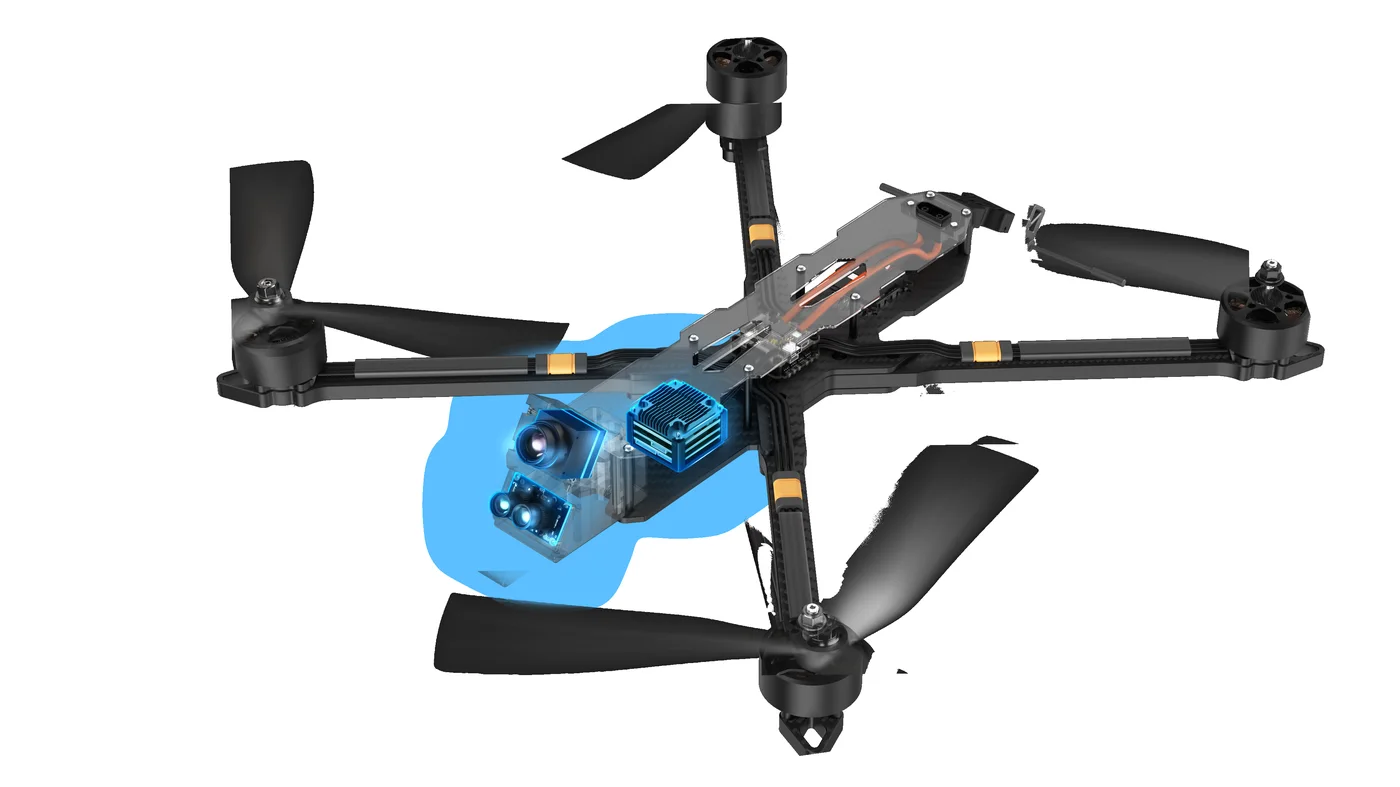
Dual visible cameras and dual-spectrum imaging solve different problems
Dual visible means two cameras working in the visible band. A wide-angle camera keeps the surrounding scene in view, while a telephoto camera provides a narrower field of view. This arrangement suits observation tasks where an operator needs context and a closer look at a small part of the scene.
Dual-spectrum usually means a visible camera and a thermal camera. The visible channel records reflected light; the thermal channel shows infrared contrast. Those are different sources of information. Adding thermal imaging does not automatically add a second visible camera, and two visible cameras do not provide thermal imaging.
VisionCube makes the distinction at configuration level. S and D are visible-only. ST and ST Pro combine one visible camera with thermal imaging. DT and DT Pro combine two visible cameras with thermal imaging. CAMCUDA AI Track uses another naming scheme: its Dual 640 configurations pair one visible camera with one thermal camera.
For example, a daylight site inspection may need a wide view to orient the operator and a narrower view to examine a defined area. An evening observation task may benefit from thermal contrast instead. A system that needs both views should be specified with both requirements from the start.
CAMCUDA AI VisionCube: six configurations compared
The following specifications come from the CAMCUDA VisionCube brochure. All six models list visible imaging at 1920 × 1080 and 30 Hz. The thermal camera resolution and rate depend on the selected model.
| Configuration | Visible cameras | AI processing | Thermal imaging | Visible optics |
|---|---|---|---|---|
| VisionCube S | One | 1 TOPS | None | 4 mm; 69° H × 42° V |
| VisionCube D | Two | 6 TOPS | None | 3.9 mm wide + 12 mm telephoto |
| VisionCube ST | One | 1 TOPS | 384 × 288 at 25 Hz | 4 mm; 69° H × 42° V |
| VisionCube ST Pro | One | 1 TOPS | 640 × 512 at 50 Hz | 4 mm; 69° H × 42° V |
| VisionCube DT | Two | 6 TOPS | 384 × 288 at 25 Hz | 3.9 mm wide + 12 mm telephoto |
| VisionCube DT Pro | Two | 6 TOPS | 640 × 512 at 50 Hz | 3.9 mm wide + 12 mm telephoto |
The D-family wide view is 72° H × 45° V; the telephoto view is 26° H × 15° V. Thermal-equipped models use 12 μm pixels and a 9.1 mm lens. The 384 thermal configuration lists 20.3° H × 15.2° V, while the 640 configuration lists 45.9° H × 36.9° V. The same focal length can therefore produce different coverage when detector formats differ.
The processing board lists CRSF communication, Betaflight support, a 9–16 V input, a 25.5 × 25.5 mm mounting pattern and dimensions of 38 × 38 × 29 mm. Its 43.8 g weight is the board reference, rather than the complete camera kit. Leave space for the selected cameras, cables, mounting and enclosure.
The brochure describes recognition of people and vehicles, picture-in-picture and a maximum of 50 recognized objects in view. Its range references differ by family: S-family models list 450 m for vehicles and 170 m for people; D-family models list 1,200 m and 500 m. These are specification references under the supplier’s conditions, not guaranteed recognition distances for every scene.
AI camera module comparison: VisionCube, AI Track, ERDI and SIYI
These products represent different integration approaches. VisionCube and AI Track include specified camera configurations. ERDI’s AS1200 listing describes a dual-visible system. SIYI AI Tracking Module II is a processing accessory for compatible cameras and optical pods. A processor-only accessory does not have an intrinsic camera resolution or lens field of view.
| Parameter | CAMCUDA VisionCube D | CAMCUDA AI Track 4 / 6 TOPS AI |
ERDI AS1200 | SIYI AI Tracking Module II |
|---|---|---|---|---|
| Product boundary | Processing board + dual visible camera configuration | Processing board + one visible camera; thermal on Dual 640 versions | Processing board + dual visible camera listing | AI processing accessory; compatible camera/pod separate |
| Published compute | 6 TOPS | 4 or 6 TOPS by model | 6 TOPS | 10 TOPS at INT8 |
| Visible imaging reference | 1920 × 1080 at 30 Hz | 4T: 2160 × 1440 at 60 Hz; 6T: 1920 × 1080 at 120 Hz | 1920 × 1080 at 30 Hz video input | Depends on the connected camera |
| Visible optics | 3.9 + 12 mm; 72° + 26° horizontal views | 4T: 4.37 mm, 109° H; 6T: 8.45 mm, 57.1° H | 3.9 + 12 mm; 72° + 26° horizontal views | Depends on the connected camera |
| Thermal provision | None on D; DT: 384/25 Hz; DT Pro: 640/50 Hz | Dual 640 versions: 640 × 512 at 50 Hz | Not listed for this configuration | Through compatible thermal-capable pod |
| Power input | 9–16 V | Regulated 9–16 V reference | 9–16 V | 11–25.2 V on English specification page |
| Processing-board dimensions | 38 × 38 × 29 mm | 4T: 38 × 38 × 24.5 mm; 6T table: 45 × 45 × 26 mm* | 38 × 38 × 29 mm | 52 × 52 × 29 mm |
| Integration reference | CRSF; Betaflight | CRSF; Betaflight and ArduPilot references | CRSF over UART; CVBS output; Betaflight | H.264/H.265 streams; compatible ZT30, ZT6, ZR30, ZR10 and A8 mini |
Reviewed 19 October 2026. Sources: VisionCubeOnboard AI vision, AI Track4 / 6 TOPS AI, ERDI AS1200 and SIYI II specifications. *AI Track’s product page also identifies conflicting 6T mechanical references; obtain the supplied revision’s drawing before enclosure design. SIYI’s English and Chinese pages differ on the lower voltage limit; confirm the supplied revision.
Camera-rate figures describe the listed imaging path. They do not establish the sustained rate or resolution of every external interface. In particular, a 1080p camera feeding a board with CVBS output does not make that analog output a 1080p digital stream.
Higher nominal compute can support a different processing workload, but it does not establish better recognition in a particular inspection scene. Precision, deployed model, input resolution, preprocessing and inference scheduling all matter. SIYI explicitly states INT8 for its figure; the CAMCUDA brochure does not provide an equivalent arithmetic-precision basis for a direct throughput benchmark.
Similarly, comparable board dimensions do not prove identical hardware, firmware or support. Choose the complete delivered system: cameras, processor, interface hardware, cables and software documentation.
What the wide-angle and telephoto views cover
Field of view translates a camera specification into a practical scene width. For a flat surface perpendicular to the optical axis, the geometric width is 2 × distance × tan(horizontal FOV ÷ 2). The distance is the camera-to-plane distance along that axis, rather than automatically the aircraft’s height above ground.
At a 100 m working distance, VisionCube D’s 72° wide view spans about 145.3 m; its 26° telephoto view spans about 46.2 m. With the same nominal 1920-pixel image width, the narrower view places more horizontal samples across the same object. That is the practical reason to consider the two-camera configuration.
This calculation describes coverage. It does not predict whether an AI model will recognize an object, whether motion blur will obscure detail, or how an oblique ground surface appears. Lens distortion, atmospheric conditions and installation alignment can also change the usable image.
Digital zoom is a separate feature. VisionCube’s 8× picture-in-picture enlargement changes the displayed scale; it does not create a continuously variable optical zoom lens. The 3.9 mm and 12 mm cameras provide two fixed optical views.
Plan the sample around your actual camera and host
Start with the images you need to deliver. A broad visible view, a second narrow view and a thermal channel should be separate requirements. Then state the frame rate, host interface and supported firmware for the selected configuration.
Daylight observation with context and detail
VisionCube D provides the two visible views without a thermal camera. DT and DT Pro retain that camera arrangement and add infrared imaging. A useful sample exercise is to inspect the same stationary scene through the wide and narrow views, then compare the detail that matters to the application.
Single-camera imaging with a higher listed rate
AI Track 4T and 6T provide alternative visible-camera formats and frame rates. Their different focal lengths and fields of view matter as much as the processing platform. A 109° horizontal view and a 57.1° horizontal view will frame the same installation differently.
Visible and thermal observation
Thermal imaging adds heat-pattern information for low-light observation and qualitative inspection. A 640 × 512 detector offers more samples than 384 × 288, but the lens and field of view still determine how much of the scene each pixel represents. Calibrated temperature measurement requires a separately specified thermographic configuration, calibration and accuracy.
Mechanical and electrical integration
Use a regulated supply matched to the selected board. Include connector clearance, cable routing, cooling and camera mounts in the assembly envelope. For AI Track 6T, resolve the mechanical revision before making an enclosure. For VisionCube, use its Betaflight documentation as the firmware reference; AI Track’s ArduPilot references should not be transferred to VisionCube.
Keep a short sample record: configuration, lens set, board revision, firmware, host connection and the scene conditions. It makes sample-to-production discussions much clearer than a product-family name alone.
Frequently asked questions
Does a dual visible AI camera module include thermal imaging?
No. Dual visible means two visible-light cameras. VisionCube D is visible-only; DT and DT Pro add a separate thermal camera.
Which VisionCube models have 640 × 512 thermal imaging?
ST Pro and DT Pro. Both list 640 × 512 thermal imaging at 50 Hz; ST Pro has one visible camera and DT Pro has two.
Is VisionCube D’s 8× PiP zoom optical zoom?
No. It is digital enlargement in the picture-in-picture view. The dual visible assembly uses separate 3.9 mm wide-angle and 12 mm telephoto lenses.
Can I compare 6 TOPS and 10 TOPS as camera accuracy?
No. TOPS describes nominal processing capacity. Recognition accuracy also depends on the model, arithmetic precision, imagery and scene conditions.
Does the thermal camera provide calibrated temperatures?
The listed VisionCube thermal specifications describe imaging. A calibrated measurement range and accuracy are not specified; include thermography requirements in your project enquiry.
Can I order a sample before a production quotation?
Yes. Select the exact configuration on the product page for current sample pricing and availability. For 100 or more units, send the selected configuration and quantity for a volume quotation.
Product specifications and further reading
- CAMCUDA AI VisionCube English brochure — configuration, optics and board specifications.
- CAMCUDA AI Track product specifications — four imaging configurations and mechanical notes.
- ERDI AS1200 product specifications — published dual-visible system parameters.
- SIYI AI Tracking Module II specifications — processing accessory and compatible cameras.
- CAMCUDA UAV AI tracking module selection guide — compare the current product series and request an OEM configuration.
Use the AI camera module selector and field of view calculator to compare the ten current CAMCUDA configurations and save the coverage inputs for your enquiry.
Choose the views your project needs.
Tell us your civilian application, visible and thermal requirements, working distance, host interface and quantity. We will help define the camera configuration for sample evaluation and production.