Handheld Thermal Imager Buyer’s Guide: Specs, Optics & Field Selection
Handheld Thermal Imager Buyer’s Guide: Specs, Optics & Field Selection
When you take a handheld thermal imager into the field, glossy sales brochures and marketing buzzwords stop mattering fast. Out in the mud, down in a crawlspace, or scanning a damp perimeter fence at 0300, what counts is raw sensor physics, optical quality, and solid electro-optical engineering. Whether you’re running multi-kilometer search and rescue grids, locking down high-security facility perimeters, or troubleshooting switchgear running under heavy load, your imager’s performance comes down to a hard balance: microbolometer resolution, pixel pitch, lens aperture (F-number), and dynamic thermal response. Cut corners on thermal sensitivity or settle for a sluggish refresh rate, and you get image blur, slow target acquisition, and bad operational calls.
Here’s the deal: system engineers and procurement leads are always balancing total payload weight and battery life against optical magnification and clean sensor data. Moving from bare core modules to a sealed, field-ready handheld platform means digging into ingress ratings, drop survival, multispectral sensor alignment, and thermal drift stabilization. This guide cuts through the fluff to deliver an honest, technical roadmap for evaluating, selecting, and running high-grade handheld thermal imagers across tough industrial and tactical deployments.
Table of Contents
- 👉 1. Core Physics & Uncooled Sensor Architecture
- 👉 2. Optics, Focal Length & Field of View (FOV) Dynamics
- 👉 3. Temporal Resolution: 50Hz Refresh vs. Dynamic Motion Smear
- 👉 4. Dual-Light Optical Fusion vs. Pure LWIR Imaging
- 👉 5. Field Ruggedization, Thermal Shock & Ingress Engineering
- 👉 6. Field Product Comparison: Ura-Z vs. Ura-Y Series
- 👉 7. B2B Procurement & RFQ Specification Framework
- 👉 8. Frequently Asked Questions (FAQ)
1. Core Physics & Uncooled Sensor Architecture
Every solid handheld thermal imager starts with its Focal Plane Array (FPA). In uncooled long-wave infrared (LWIR, 8 to 14 micrometers) setups, the detector uses Vanadium Oxide (VOx) or Amorphous Silicon (a-Si) microbolometer designs. In the shop, we lean heavily toward Vanadium Oxide. VOx gives you a much better Temperature Coefficient of Resistance (TCR), delivering higher Signal-to-Noise Ratios (SNR) and lower Noise Equivalent Temperature Differences—consistently sub-30 to 40 mK in good units. When incoming infrared energy hits the suspended microbolometer membrane, its electrical resistance shifts based on absorbed heat. That resistance delta is read line-by-line by the Read-Out Integrated Circuit (ROIC), turning minute analog thermal differences into a clean, workable digital stream.
The industry shift from legacy 17-micrometer pixel architectures down to modern 12-micrometer nodes is a massive practical win. Shrinking the pixel pitch allows us to pack high-resolution arrays—like 640×512 pixels—onto much tighter silicon dies. In a handheld housing where every cubic millimeter counts, that footprint reduction pays dividends across the entire optical and power chain.
Look at the optical knock-on effects: a smaller sensor die means optical engineers can use shorter focal length lenses to get the exact same instantaneous field of view and spatial resolution that used to demand massive, heavy Germanium glass. Germanium is dense, heavy, and expensive. Shrinking the optical train directly trims physical bulk and cuts carry weight. On top of that, 12-micrometer microbolometers feature wafer-thin structural membranes with lower thermal mass. That translates to faster thermal time constants, cutting down on image ghosting and smearing when panning past high-contrast thermal signatures.
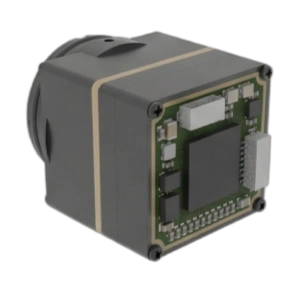
For bench teams prototyping custom systems or running modular builds, integrating high-density thermal imaging cores built on 12-micrometer foundations can slash internal electronic payload mass by up to 40 percent. That frees up vital internal volume and battery weight for higher-capacity cells, onboard image signal processors, and rubberized shock dampening mounts.
2. Optics, Focal Length & Field of View (FOV) Dynamics
Infrared optics play by completely different rules than visible-light glass. Standard optical crown or flint glass turns totally opaque in the LWIR 8 to 14 micrometer band. Handheld thermal gear instead relies on precision-ground polycrystalline Germanium (Ge), Chalcogenide glasses, or Zinc Selenide (ZnSe). These optical elements are hard-coated with Diamond-Like Carbon (DLC) on exterior surfaces and multi-layer anti-reflective (AR) treatments internally to resist airborne grit, blowing sand, acidic atmospheres, and corrosive salt-fog in coastal areas.
An imager’s real-world operational envelope comes down to the geometry between detector pitch, active sensor resolution, and optical focal length. The Instantaneous Field of View (IFOV) defines the exact spatial angle a single detector pixel covers at range. It boils down to a fundamental optical formula:
IFOV = Pixel Pitch (p) / Lens Focal Length (f)
Let’s run the numbers: a 12-micrometer detector mated to a 35mm lens yields an IFOV of roughly 0.343 milliradians. Swap that out for a 70mm telephoto optic on the same 12-micrometer array, and your IFOV drops down to about 0.171 milliradians. Halving the IFOV doubles the pixel density across a target at any given distance, directly extending your detection, recognition, and identification range under standard Johnson Criteria modeling.
| Johnson Criteria Stage | Required Pixels on Target | Operational Field Meaning |
|---|---|---|
| Detection Threshold | 1.5 to 2.0 pixels across critical dimension | Target is present; anomaly distinguishable from background noise. |
| Recognition Threshold | 6.0 to 8.0 pixels across critical dimension | Classify object type (e.g., distinguishing a human from a quadruped animal or light vehicle). |
| Identification Threshold | 12.0+ pixels across critical dimension | Positive identification (e.g., distinguishing specific vehicle models or equipment structural states). |
When selecting optics, you are always trading spatial reach against situational awareness. A wide horizontal field of view (like 12.6 degrees) is mandatory for close-in site sweeps, indoor building checks, and dynamic patrol routines where losing your peripheral vision gets you disoriented. On the flip side, a tight FOV (around 7.0 degrees horizontal) concentrates maximum pixels downrange, making it the right pick for stand-off perimeter monitoring, coastal observation, and border surveillance.
For industrial thermographers running calibrated condition monitoring, adhering to standards like the ASTM E1934 Infrared Thermography Guide ensures measurement consistency during electrical switchgear and building envelope audits. Benchmarking against purpose-built radiometric systems from metrology specialists like Workswell is also a reliable way to verify qualitative field imagery against rigorous quantitative temperature data.
3. Temporal Resolution: 50Hz Refresh vs. Dynamic Motion Smear
Temporal resolution is one spec that looks minor on paper but makes or breaks handheld field operations. Unlike a static thermal camera bolted to a rigid pan-tilt mount, a handheld unit is constantly dealing with hand tremors, footsteps, and fast sweeping pans. If your spatial resolution is 640×512 but your refresh rate is sluggish, the display turns into a smeared mess the second you move.
Low-refresh thermal devices capped at 9Hz (often done to dodge strict international export controls) update the screen once every 111 milliseconds. Pan a 9Hz optic across a 90-degree sector at a normal walking sweep rate of 15 to 30 degrees per second, and the whole image turns to soup. You get harsh motion tearing, operator eye strain, motion sickness, and worst of all, you will completely miss brief, fleeting heat flashes behind sparse brush or tree lines.
A proper 50Hz (50 frames per second) pipeline updates the micro-display buffer every 20 milliseconds. That keeps pace with human visual processing. Whether you’re scanning fence lines from a rolling utility vehicle or tracking quick targets across open fields, 50Hz video yields crisp edge boundaries, zero perceived stutter, and instant spatial feedback. When seconds count, you can’t afford a display that drags behind reality.
4. Dual-Light Optical Fusion vs. Pure LWIR Imaging
Standalone LWIR thermal sensors detect radiated heat flux. That makes thermal unbeatable for seeing through total darkness, light haze, smoke, and thin brush. But raw LWIR has blind spots that can trip up field operators:
- ❌Zero Text and Signage Visibility: Painted labels, safety warnings, hazard placards, and vehicle markings are usually the same temperature as the metal or plastic they sit on. On pure thermal, they are completely invisible.
- ❌Reflective Illusions: Polished sheet metal, glass panels, and calm water bounce background thermal energy like mirrors, creating phantom cold or hot spots that fool the eye.
- ❌Thermal Equilibrium Washout: During dusk transitions or right after heavy rain, objects and their backgrounds equalize in temperature, leaving pure LWIR images looking flat with little structural definition.
Dual-light optical fusion solves this by packing both a 640×512 LWIR thermal engine and a high-resolution low-light CMOS sensor into a single, bore-sighted chassis. An onboard digital signal processor runs real-time edge-detection algorithms—using spatial Sobel, Prewitt, or Laplacian filters—to extract high-frequency detail from the visible channel and overlay those crisp outlines directly on top of the thermal heat map.
- ✅Instant Target & Text Context: Operators can easily read equipment ID tags, spot open breaker labels, and identify warning signs while retaining full thermal visibility.
- ✅Sharp Geometric Outlines: Clear edge extraction outlines fence perimeters, window frames, building access points, and terrain contours.
- ✅Faster Decision-Making: Eliminates the need to constantly switch back and forth between separate visible and infrared optics.
5. Field Ruggedization, Thermal Shock & Ingress Engineering
The cleanest sensor in the world is useless if the housing fails during the first rainstorm or cracks on a hard vehicle deck. For mission-critical gear deployed anywhere from sub-zero northern job sites to scorching desert perimeters, mechanical ruggedization and ingress engineering are non-negotiable.
Ingress protection must meet at least IP66. That guarantees the unit is fully dust-tight against blowing dirt and sealed against heavy, high-pressure water jets. Handheld bodies should be cast from high-grade magnesium-aluminum alloy or glass-reinforced structural polycarbonates with tactile rubber over-molds. That keeps drop shock from shattering internal lens alignments while keeping total carry weight under 1.0 kg to avoid wrist and shoulder fatigue during all-night patrols.
Wide temperature stability is another critical hurdle. Handheld platforms need to stay dead-on from -40°C up to +50°C. Big ambient shifts cause physical expansion in lens barrels and shift microbolometer baseline voltages, creating Fixed Pattern Noise (FPN) and thermal drift. Quality handheld units counter this with automated Non-Uniformity Correction (NUC) cycles using ultra-quiet internal shutters or advanced shutterless firmware algorithms. For teams building custom observation rigs, reviewing standalone uncooled thermal modules provides great insight into how baseline temperature compensation is handled under the hood.
6. Field Product Comparison: Ura-Z vs. Ura-Y Series
Camcuda manufactures dedicated handheld thermal observation platforms built specifically for facility security, tactical search, and long-range perimeter sweeps. Here is how two of our core field-proven systems compare on the bench:
Platform 1: Ura-Z Series Dual-Light Fusion Handheld Thermal Observer
The Ura-Z Series is a dual-light fusion handheld thermal observer combining thermal and low-light observation modes for outdoor search, visibility enhancement, site patrol, and field documentation workflows. Engineered for mobile field teams requiring both thermal contrast and visible edge sharpness, the Ura-Z provides flexible situational awareness within a rugged, compact form factor.
| Thermal Resolution | 640 x 512 |
|---|---|
| Pixel Pitch | 12 µm |
| Optical Lens | 35 mm manual focus |
| Field of View (FOV) | 12.6° x 10.1° |
| Observation Modes | Thermal, Low-Light, and Optical Fusion |
| Operating Temperature | -40°C to +50°C |
| Ingress Protection | IP66 |
| Physical Dimensions | ≤ 153 x 150 x 68 mm |
| Total Weight | ≤ 1.0 kg |
Operational Fit: The Ura-Z Series is ideal for tactical search operations, industrial perimeter patrols, safety and rescue support, and outdoor monitoring where combining low-light context with thermal signatures enables rapid environmental navigation and clear target documentation.
Platform 2: Ura-Y Series 640×512 Handheld Thermal Observation Binocular
The Ura-Y Series is a dedicated 640×512 handheld thermal observation binocular platform designed for outdoor search, perimeter review, and field inspection. Built with a high-aperture 70mm F1.0 optical assembly and a smooth 50fps frame rate, the Ura-Y excels at long-range stand-off detection and continuous tracking across open terrain.
| Sensor Type | VOx uncooled sensor |
|---|---|
| Resolution | 640 x 512 |
| Pixel Size | 12 µm |
| Temporal Frame Rate | 50 fps (50 Hz) |
| Optical Lens | 70 mm F1.0 |
| Field of View (FOV) | 7.0° x 4.8° |
| Weight Class | Approx. 1.0 kg class |
| Primary Application Profile | Long-Range Search, Perimeter Observation, Field Inspection |
Operational Fit: The Ura-Y Series is tailored for field teams requiring extended stand-off observation range, high refresh rates for dynamic tracking, and binocular ergonomics that minimize eye strain during long-duration perimeter monitoring and outdoor surveillance.
7. B2B Procurement & RFQ Specification Framework
Sourcing electro-optical gear for commercial, industrial, or security outfits requires pin-point technical alignment between your operational needs and factory build specs. Vague procurement sheets lead to wrong optical configurations, under-spec refresh rates, or surprise export paperwork delays. Locking down a strict RFQ spec framework keeps your project on schedule and eliminates costly field mismatches.
When drafting an RFQ, make sure your engineering and procurement teams nail down these core operational criteria:
- ⚙️Target Profiles & DRI Ranges: Explicitly state your target dimensions (such as standard 1.8m x 0.5m human silhouettes or vehicle dimensions) and required Detection, Recognition, and Identification distances. This determines whether you need a 35mm wide-angle setup or a 70mm telephoto lens.
- ⚙️Spectral Imaging Modes: Define whether your protocols need raw LWIR thermography or dual-light visible fusion for reading equipment nomenclature, safety placards, and navigating structural hazards.
- ⚙️Temporal Refresh Rates: Specify if the mission involves mobile foot patrols, vehicle-mounted scanning, or fast targets requiring a true 50fps output to prevent motion blur and operator disorientation.
- ⚙️Environmental & Mechanical Limits: Demand proven IP ratings (IP66 minimum), wide operating temperature tolerances (-40°C to +50°C), compact envelopes (≤153 x 150 x 68 mm), and strict weight caps (≤1.0 kg) to keep operators effective over long shifts.
- ⚙️Power Logistics & Interface Ecosystem: Confirm continuous battery runtimes, hot-swap options, rugged transit cases, charging docks, and physical video taps (USB, HDMI, or CVBS).
- ⚙️Regulatory & Export Compliance: Verify country-of-origin documentation, ECCN dual-use export classifications, and NDAA compliance statements upfront before issuing purchase orders.
To dive deeper into mechanical integration blueprints, sensor specs, and procurement workflows, check out our technical engineering hub at the Camcuda Support & FAQ Knowledge Base.
8. Frequently Asked Questions (FAQ)
What are the engineering tradeoffs between a dedicated handheld thermal imager and a smartphone plug-in module?
Why is a 50Hz frame rate critical for walk-and-scan observation?
When should teams choose dual-light fusion over standalone uncooled LWIR thermal?
How does pixel pitch (12µm vs. 17µm) impact handheld optical weight and field ergonomics?
📚 References & Further Reading
- Industry Standard: ASTM E1934 Standard Guide for Examining Electrical and Mechanical Equipment with Infrared Thermography
- Radiometric Metrology Partner: Workswell Advanced Thermal Imaging & Measurement Systems
- Related Engineering Guide: Camcuda High-Resolution Uncooled Thermal Imaging Cores
- Product Category Overview: Camcuda Uncooled Thermal Modules & Integration Platforms
- Support Knowledge Base: Camcuda Electro-Optics FAQ and Integration Documentation