CAMCUDA / OPTICAL PLANNING
Thermal Camera Lens Selector
Choose a thermal camera lens from the scene you need to see. Set your application, working distance, target detail and coverage width; compare focal lengths, field of view and pixels on target in one place.
Based on the CAMCUDA lens and range reference. Results are calculated optical estimates, not measured detection ranges or a list of available product configurations.
STARTING POINT FOR YOUR OPTICAL DESIGN The shortest listed lens meeting both constraints will appear here.
Diagram is conceptual. Blue shows the calculated field; the orange bar represents the requested horizontal coverage. Dimensions are measured on a flat plane perpendicular to the optical axis.
Enter your requirements
Enable JavaScript for interactive recommendations. The application examples, formulas and lens guide below remain available without JavaScript.
Compare every candidate thermal camera lens
The highlighted row is the widest-view candidate that meets your requirements. The table also shows why other focal lengths do not fit. “Threshold distance” uses your target dimension, detail setting and margin; it is not a validated operating range.
| Focal length | Calculated FOV | IFOV (mrad) | Scene width | Target pixels | Threshold distance | Fit |
|---|
6 application starting points
These worked scenarios explain the presets. They use 640 × 512 pixels, 12 μm pitch, a six-pixel threshold and no additional margin. Change every input to match your site before selecting an optical assembly.
Perimeter observation
A 0.5 m human-width target at 100 m, with at least 40 m of scene coverage, selects 15 mm from the guide. It gives 6.25 pixels across the target and a 51.2 m horizontal field. Camera placement and tested analytics remain part of the system design.
Vehicle observation
A 1.5 m vehicle dimension at 300 m, with 100 m minimum coverage, also selects 15 mm. This is a different target and distance with the same angular size. The calculation does not establish license-plate reading or vehicle identity.
Small hot spots
A 0.2 m hot spot at 30 m, across a 10 m inspection area, selects 15 mm and gives 8.33 pixels across the feature. A calibrated measurement needs the camera’s specified measurement field of view, temperature range and correct environmental settings.
UAV ground inspection
For a perpendicular view at 100 m AGL, a 15 mm lens covers approximately 51.2 × 40.96 m. A 0.5 m ground feature spans 6.25 pixels. Tilt, terrain, motion and required image overlap change the flight-planning problem.
Wildlife observation
A 0.3 m critical dimension at 200 m, with a 25 m scene width, selects 50 mm. Its 30.72 m horizontal field trades search area for more target pixels. This example does not claim species identification through vegetation.
Equipment inspection
A 20 mm feature at 5 m, with 2 m required coverage, selects 19 mm from the guide. The detail occupies about 6.33 pixels. The final lens must focus at that distance and support the selected radiometric calibration.
How the thermal camera lens selector calculates a match
Let p be pixel pitch in millimeters, f focal length in millimeters, N horizontal detector pixels, D distance in meters, and T the target’s critical dimension in meters. The geometric pixel footprint is D × p / f, so target pixels are T × f / (D × p). The required focal length is therefore target pixels × D × p / T. The tool multiplies your chosen detail threshold by the selected pixel margin before applying that expression.
Horizontal scene coverage is D × N × p / f. If you specify a minimum scene width, that creates an upper bound on focal length. A useful lens must satisfy both bounds. The tool chooses the shortest listed focal length in the feasible interval. A larger focal length may provide more target detail, but it always gives up scene width in this model.
Angular field of view uses 2 × atan(sensor size / (2 × focal length)), independently for the horizontal and vertical axes. IFOV is the central small-angle estimate p / f, expressed in milliradians. These are ideal rectilinear calculations; distortion, focus distance, active image crop and the supplied lens’s effective focal length can change the actual view. See our explanation of why 640 / 15 mm FOV specifications differ.
The guide’s three reference groups are modeled as 256 × 192 / 12 μm, 384 × 288 / 17 μm and 640 × 512 / 12 μm. The pitches are inferred from the guide’s focal-length and IFOV combinations. Custom mode is available for other detectors, including 8 μm designs. Confirm actual pitch against the camera datasheet rather than choosing by resolution alone.
The tool recalculates every row from these assumptions. Printed FOV and range entries in the supplied reference may use different rounding or optical data; they are not treated as interchangeable with the calculated figures. The original CAMCUDA lens and range reference PDF remains available for comparison. For individual optical checks, use the thermal imaging FOV, IFOV and DRI calculator.
Connect the lens choice to a camera module
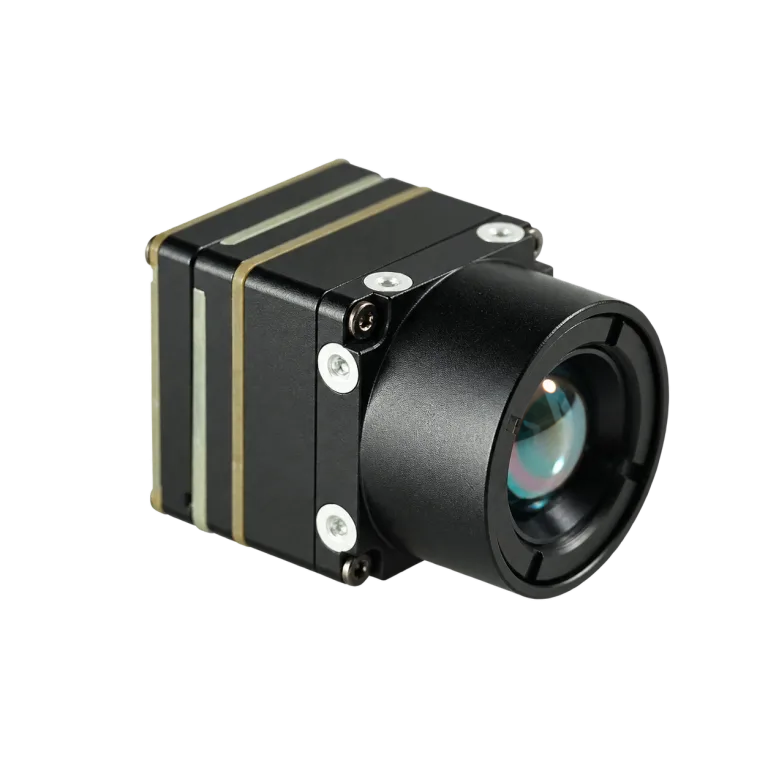
AeroMini 640
Explore the 640 × 512, 12 μm UAV core and its current lens options. The radiometric version has its own documented lens list; an imaging lens recommendation does not automatically apply to that version.
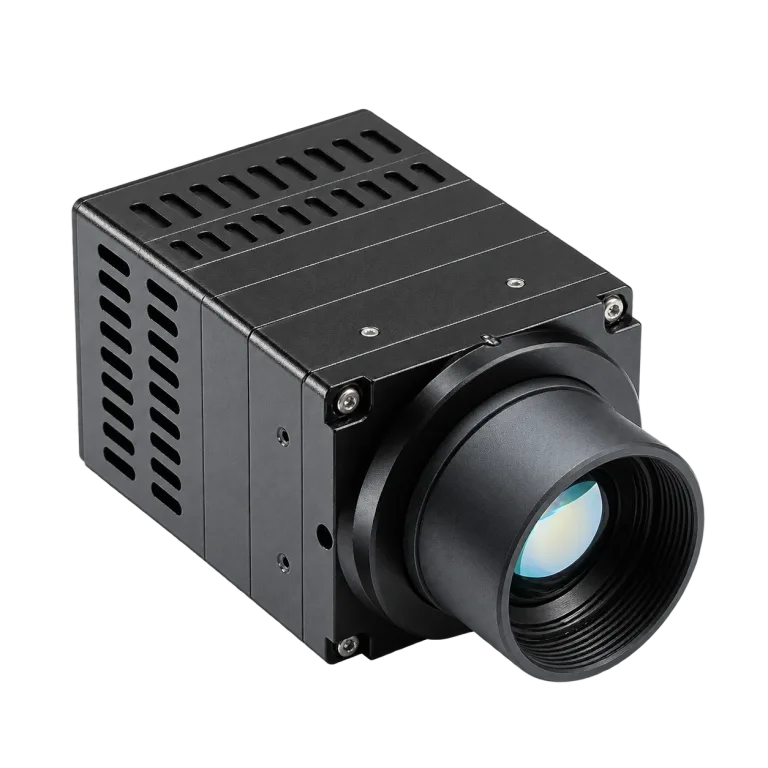
ThermoCore IP 640
Consider a 640 × 512, 12 μm Ethernet radiometric module for fixed monitoring and industrial integration. Request the matched lens and measurement configuration with your project brief.
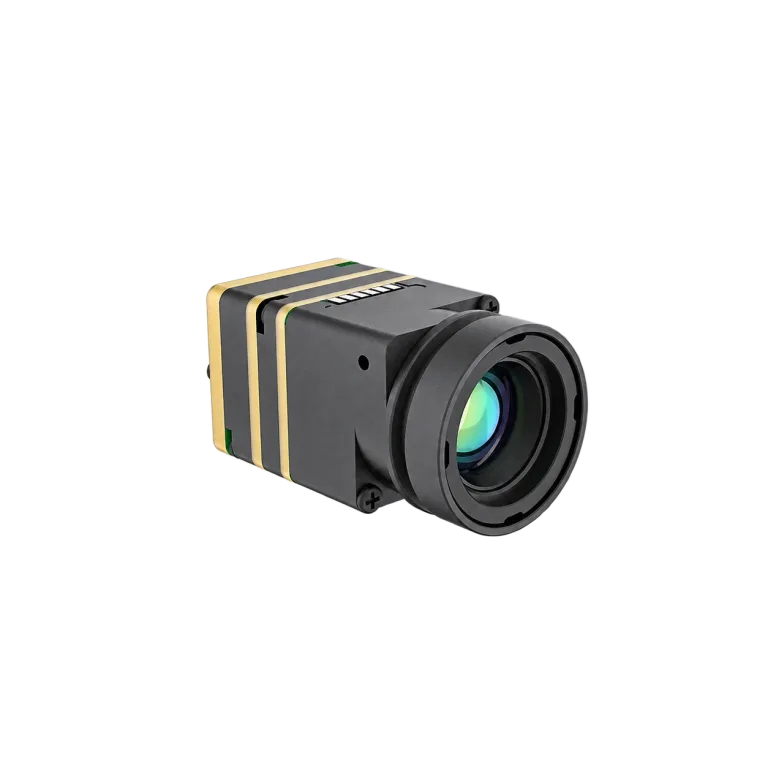
SuperMini 640 / 640T
This series uses 8 μm pixels, so the guide’s 12 μm 640 profile does not represent it. Use custom detector mode for geometric comparison, then refer to its actual lens table and version boundaries.
Lens candidates here are reference focal lengths, not promises of stock, mounting compatibility, or availability across CAMCUDA products. Use the RAW thermal module selector when radiometric output and host data format are also part of your decision.
Thermal camera lens selector FAQ
Which thermal camera lens is best for my application?
Choose from the required target detail, distance and scene coverage. Enter those values in the selector. A 15 mm lens can fit the illustrated 100 m perimeter scenario, while a 50 mm lens fits the smaller 0.3 m target at 200 m. Neither focal length is universally best.
Why does the selector sometimes recommend no lens?
A single view may not have enough detector pixels to provide both the requested coverage and target detail. A longer lens improves detail but narrows the scene. Change the geometry or consider multiple views; do not assume that a still longer lens solves both requirements.
Does identification at 12 pixels mean facial recognition?
No. The label follows the supplied guide’s simplified optical planning convention. Twelve pixels across a critical dimension do not establish individual identity, number-plate reading, species classification or an AI accuracy percentage.
Can I use these distances for temperature measurement?
Not directly. A radiometric camera needs a specified measurement spot, suitable calibration, focus and environmental settings. The Optris optics calculator distinguishes IFOV from a model-dependent measurement field. Use your selected camera’s documented measurement requirement.
Can I share a selection without creating duplicate indexed URLs?
Yes. Share selection saves inputs in the URL fragment after the # symbol. The page keeps one clean canonical address. The shared link restores the application and dimensions when opened; calculations remain in your browser.
Does a 640 detector always see farther than a 256 detector?
At the same pixel pitch and focal length, the central pixel footprint is the same. More pixels mainly increase the total scene coverage. At the same field of view, a higher detector resolution can put more pixels on the target.
Related references: focal length · field of view · IFOV · all engineering tools.