Drone with IR Camera: Engineering Guide to Thermal Payloads and OEM Modules
Drone with IR Camera: Engineering Guide to Thermal Payloads and OEM Modules
Slapping a drone with an IR camera onto an airframe isn’t just about sticking another sensor in the air—it fundamentally changes how you gather intelligence. You’re shifting flight operations from daylight-dependent visible cameras to 24/7 radiometric surveillance. Visible-spectrum electro-optical (EO) glass depends entirely on bouncing ambient sunlight off a target. Long-wave infrared (LWIR) payloads don’t care about ambient light. They read passive thermal radiation emitted by literally anything above absolute zero (-273.15°C). For systems engineers, UAV payload designers, and enterprise program managers, integrating an aerial thermal imager means balancing raw sensor physics, optical transmission windows, thermal sensitivity metrics, and unforgiving SWaP-C (Size, Weight, Power, and Cost) envelopes.
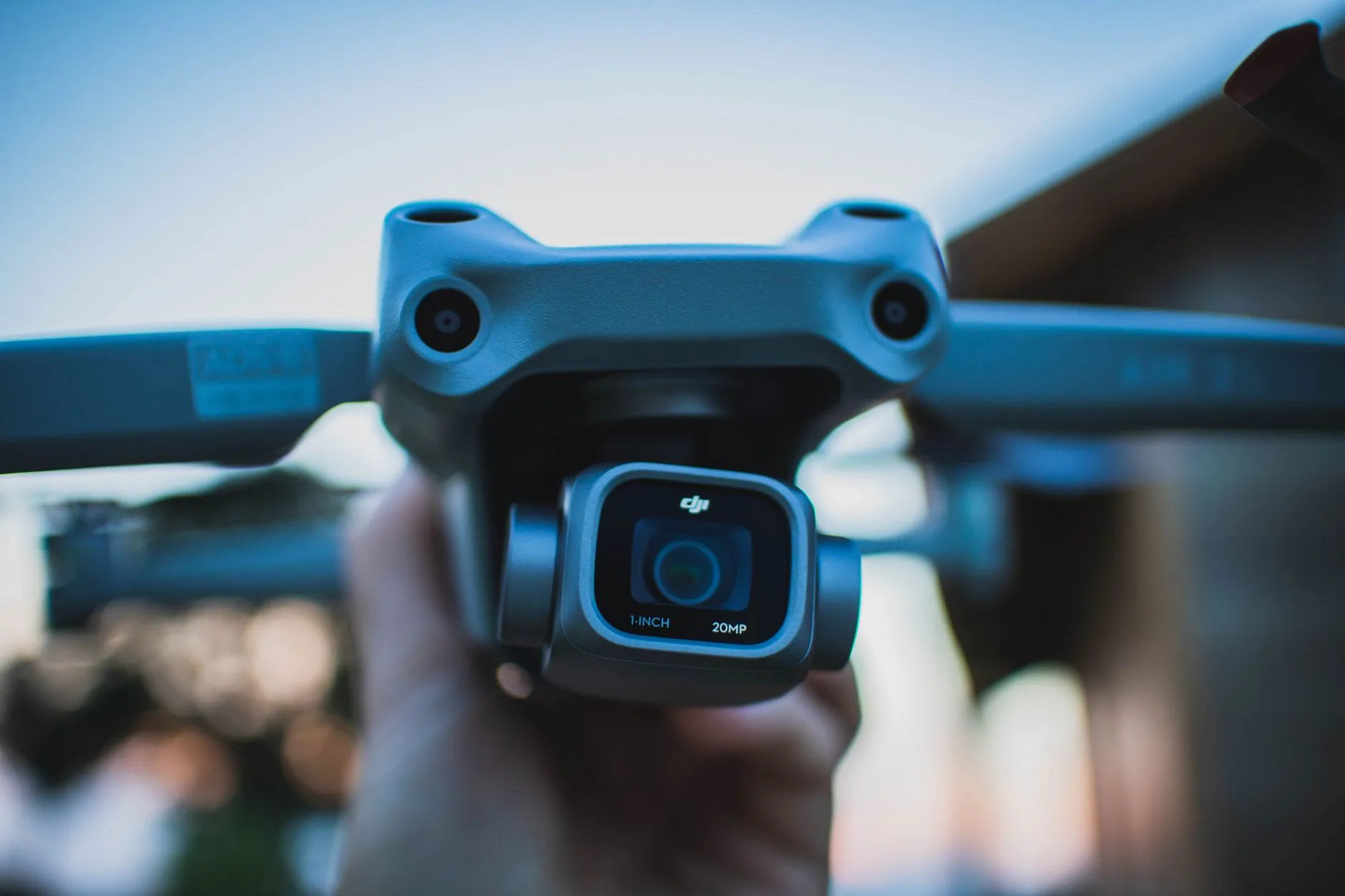
Integrating uncooled Vanadium Oxide (VOx) microbolometers into a quad, hex, or fixed-wing platform is a mechanical and electrical challenge. When you’re in the air, you’re fighting high-frequency motor harmonics, wild ambient temperature swings, prop wash, and sudden aerodynamic buffet. If your gimbal isn’t tuned or your thermal core lacks proper non-uniformity correction, your imagery turns into a smeared, noisy mess. This technical guide breaks down the core hardware realities of drone IR payloads—from sensor pixel pitch and Noise Equivalent Temperature Difference (NETD) to Germanium lens selection, radiometric calibration, edge AI pipelines, and embedded bus integration.
Table of Contents
- 👉 1. Infrared Spectral Bands: LWIR vs. MWIR vs. NIR in Aerial Systems
- 👉 2. Thermal Core Architecture: VOx Microbolometers, Pitch, and NETD
- 👉 3. UAV Payload Architecture: Gimbal Stabilization, Interfaces, and SWaP-C
- 👉 4. IR Optics Engineering & DRI Calculations (Johnson’s Criteria)
- 👉 5. Radiometric Calibration, Temperature Accuracy, and Edge Analytics
- 👉 6. Core Hardware Matrix & Field Equipment Showcase
- 👉 7. Build vs. Buy: Integrating OEM Modules vs. Turnkey Payloads
- 👉 8. Field Deployment Profiles: Utility Grid, Solar, and Security Workflows
- 👉 9. Deep-Dive Technical FAQ
1. Infrared Spectral Bands: LWIR vs. MWIR vs. NIR in Aerial Systems
Here’s the deal with the electromagnetic spectrum: picking an infrared sensor band determines your detector chemistry, cooling hardware, optical glass costs, and how long your bird stays in the air. You can’t just slap any “night vision” sensor on a gimbal and expect true thermographic analysis.
| Spectral Band | Wavelength Range | Detector Architecture | Aerial Suitability & SWaP Constraints |
|---|---|---|---|
| Near-Infrared (NIR) | 0.75 – 1.4 μm | Silicon CMOS (IR filter removed) | Requires active illumination (850/940nm) or ambient moonlight; zero true heat measurement capability. |
| Short-Wave Infrared (SWIR) | 1.4 – 3.0 μm | Indium Gallium Arsenide (InGaAs) | Pierces heavy atmospheric haze and checks solar cell electroluminescence; exceptionally high sensor cost. |
| Mid-Wave Infrared (MWIR) | 3.0 – 5.0 μm | Indium Antimonide (InSb) / MCT (Cooled) | Incredible standoff range (10km+); demands a cryocooler at 77K, pulls 20–50W, weights >1.5kg. Tactical-tier only. |
| Long-Wave Infrared (LWIR) | 8.0 – 14.0 μm | Vanadium Oxide (VOx) / a-Si (Uncooled) | Direct blackbody detection (-40°C to +150°C); low power (<2.5W), light (<60g core), ideal for sub-25kg UAVs. |
For industrial field inspections and standard tactical UAVs, the Long-Wave Infrared (LWIR) band (8–14 μm) is the undisputed workhorse. Basic physics explains why: Wien’s Displacement Law dictates that terrestrial targets (humans, utility transformers, building envelopes, solar panels) emit peak radiative flux right in this exact window. Uncooled LWIR cores eliminate the massive weight, mechanical complexity, and power draw of cryogenic Stirling coolers, easily giving your multirotor 30 to 45 minutes of clean flight time.
2. Thermal Core Architecture: VOx Microbolometers, Pitch, and NETD
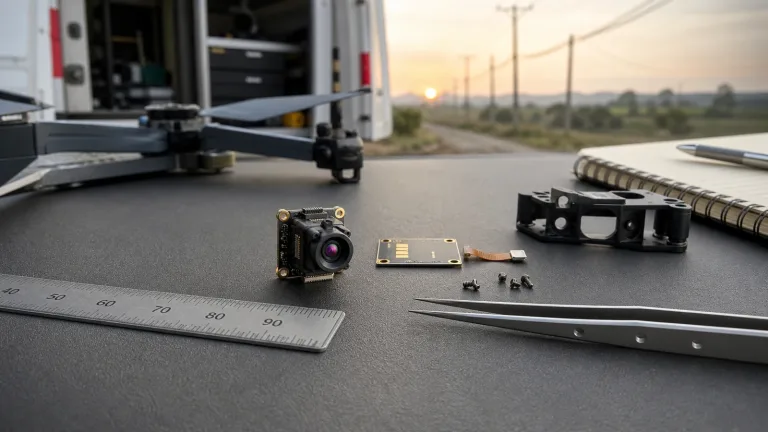
The beating heart of any drone IR payload is its Focal Plane Array (FPA). In an uncooled microbolometer, incoming infrared photons pass through Germanium glass and hit an array of tiny, suspended absorber membranes. Each pixel houses a temperature-sensitive resistive thin film. When that film absorbs heat, its electrical resistance shifts. The Readout Integrated Circuit (ROIC) scans the array, measures those resistance changes, and turns them into a calibrated digital signal.
Sensor Chemistry: VOx vs. Amorphous Silicon (a-Si)
Look, if you’re building for serious commercial or tactical specs, stick with Vanadium Oxide (VOx) over Amorphous Silicon (a-Si). In the shop, we look at the Temperature Coefficient of Resistance (TCR). VOx gives you roughly 2% to 3% resistance change per Kelvin with a noticeably lower 1/f noise floor. That gives your payload cleaner thermal contrast, snappy thermal time constants (τ ≤ 10–12 ms), and better resistance to sensor burn-in when panning across sunlit structures.
Pixel Pitch: The Jump from 17 μm to 12 μm
Shrinking pixel pitch down to 12 μm revolutionized drone payload design. Here is why it matters on the bench:
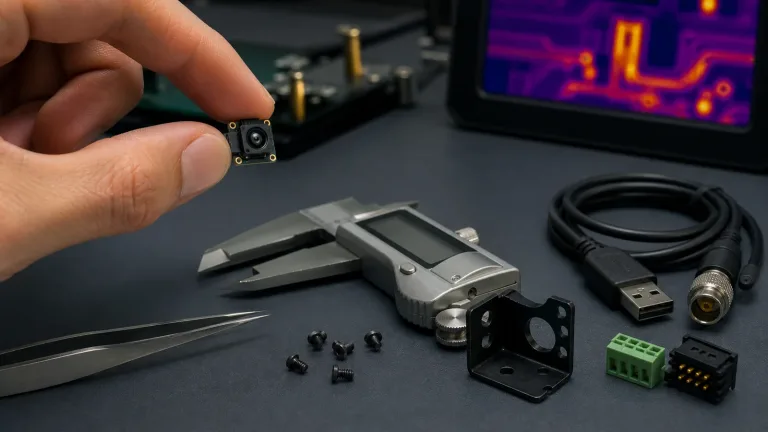
- ⚙️ Smaller Detector Footprint: A 640×512 array at 12 μm has a diagonal measurement of just 9.83 mm, compared to 13.93 mm on an older 17 μm architecture.
- ⚙️ Optics Miniaturization: To hit the same Instantaneous Field of View (IFOV), a 12 μm core needs a much shorter focal length. A 35 mm lens on a 12 μm core matches the spatial resolution that used to require a heavy 50 mm optic on a 17 μm sensor.
- ✅ Lower Gimbal Inertia: Smaller Germanium elements slash payload nose-weight. Your gimbal motors run cooler, draw fewer amps, and track tighter in high gusts.
Noise Equivalent Temperature Difference (NETD)
NETD is the ultimate metric for thermal sensitivity. It tells you the minimum temperature delta between target and background that yields a signal-to-noise ratio of exactly one. It’s measured in millikelvins (mK):
- ✅ ≤ 20 mK (Ultra-Sensitive): Picks up minuscule thermal differences. Crucial for maritime SAR, wet building envelope inspections, and overcast canopy sweeps where thermal delta is tiny.
- ⚙️ ≤ 40–50 mK (Standard Industrial): Solid baseline for high-delta targets like overloaded distribution lines, blown PV bypass diodes, and industrial plant boilers.
A lower NETD cuts down high-frequency digital grain, leaving you with razor-sharp radiometric imagery.
Frame Rates: 50Hz/60Hz vs. 9Hz
Let’s address the elephant in the room: 9Hz export-restricted sensors are fine for stationary bench mounts, but they are a nightmare on a drone. When an aircraft is cruising at 12 m/s or yawing against crosswinds, a 9Hz feed turns into a stuttering, motion-blurred slide show. For smooth aerial tracking and autonomous computer vision pipelines, a 50Hz or 60Hz high-frame-rate sensor is an absolute requirement.
3. UAV Payload Architecture: Gimbal Stabilization, Interfaces, and SWaP-C
Getting clean radiometric data requires isolating the sensor from prop turbulence, motor vibration, and sudden flight maneuvers—all while operating on a strict electrical budget.
3-Axis Brushless Gimbal Stabilization
When you screw on a narrow-FOV telephoto lens (35mm, 50mm, or 70mm), every tiny motor vibration (>100 Hz) turns into catastrophic motion blur. Professional aerial pods rely on direct-drive brushless gimbals with high-resolution magnetic encoders and dedicated IMUs polling at ≥ 1000 Hz. This closed-loop control keeps pointing accuracy locked down to ±0.01°.
Physical and Logical Data Interfaces
Connecting your thermal core to the flight stack requires picking the right interface architecture:
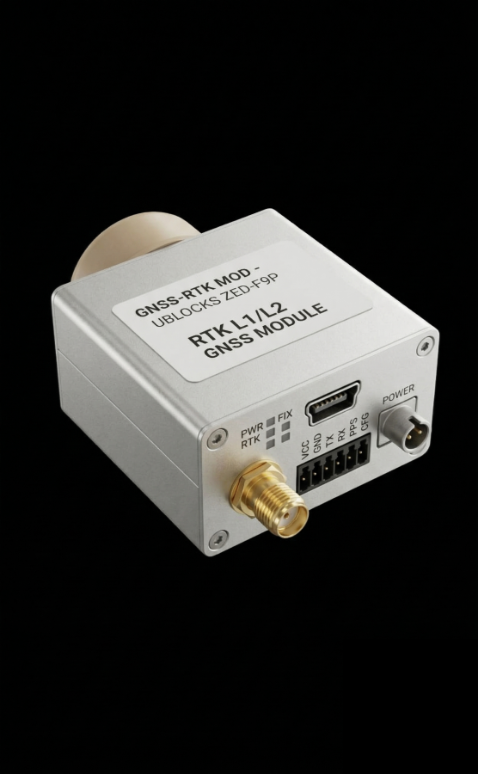
- ⚙️ MIPI-CSI2 / Parallel Digital: Feeds uncompressed 14-bit or 16-bit raw radiometric frames straight into onboard AI companion computers (like NVIDIA Jetson Orin) for zero-latency machine vision inference.
- ⚙️ USB 3.0 / Type-C: Great for rapid field bench testing, driver development, and plug-and-play embedded Linux setups.
- ⚙️ Ethernet (RTSP / UDP / H.264 / H.265): Streams compressed video alongside telemetry directly down to Ground Control Stations (GCS).
- ⚙️ Analog CVBS: Zero-latency analog composite video for dedicated 5.8 GHz FPV pilot piloting links.
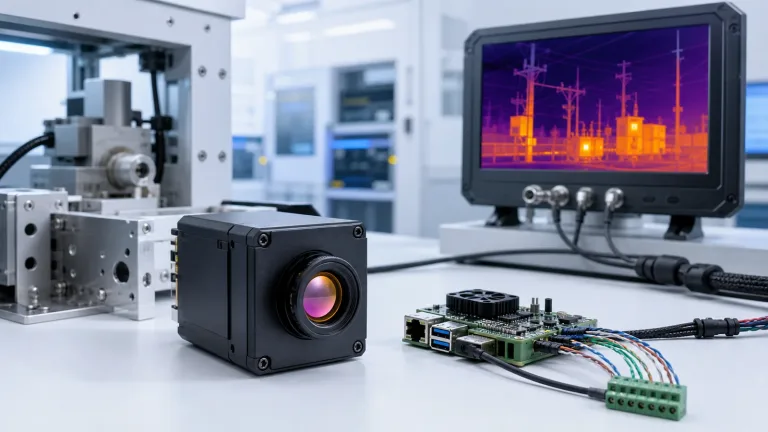
When building custom payloads, engineers often rely on modular cores like the 640×512 UAV thermal imaging camera module, which packs the sensor, optics, and video processing boards into a rugged, EMI-shielded enclosure.
| Payload Category | Typical Mass Class | Power Budget | Data Transport Protocol |
|---|---|---|---|
| Bare OEM Thermal Core | 20 g – 60 g | 3.3 – 5.0 V DC, ≤ 1.5 – 2.5 W | MIPI-CSI2, LVDS, USB 3.0, Raw 14-bit |
| Integrated 3-Axis UAV Gimbal Pod | 250 g – 650 g | 12 – 24 V DC, 6 – 14 W | Ethernet (RTSP), HDMI, MAVLink Telemetry |
| Handheld / Ground Auxiliary Device | 550 g – 1000 g | Internal Li-Ion Pack (4–8h run) | On-Screen Display, USB-C Mass Storage, Wi-Fi |
4. IR Optics Engineering & DRI Calculations (Johnson’s Criteria)
You cannot use standard crown glass for thermal imaging. Standard BK7 or silica glass is as opaque as a brick wall to LWIR photons between 8 and 14 μm. You need specialized infrared optical substrates.
Infrared Optical Substrates
- ⚙️ Monocrystalline Germanium (Ge): The industry gold standard for LWIR. Germanium has a massive refractive index (n ≈ 4.0 at 10 μm), letting engineers design fast, compact F1.0 to F1.2 lenses with minimal aberration. Because Germanium is prone to scratching, the outermost element gets treated with Diamond-Like Carbon (DLC) coating. Specialized optics manufacturers like Ophir IR Optics supply precision elements engineered to withstand rough flight environments.
- ⚙️ Chalcogenide Glass: An amorphous matrix made of selenium, sulfur, and tellurium. It can be hot-molded into aspheric profiles, cutting manufacturing costs for high-volume builds while keeping thermal focus stable across wide operational temperatures.
Instantaneous Field of View (IFOV) & Ground Resolution
Instantaneous Field of View (IFOV) defines the exact spatial angle covered by an individual pixel. It governs how fine a detail you can resolve from altitude:
IFOV (mrad) = [Pixel Pitch (p in μm) / Lens Focal Length (f in mm)]
Let’s run the numbers on a 12 μm sensor behind a 50 mm lens:
IFOV = 12 / 50 = 0.24 mrad
If you’re hovering at an altitude (standoff distance D) of 100 meters, your Ground Sampling Distance (GSD) per pixel is:
GSD = 100 m × 0.00024 rad = 0.024 m = 2.4 cm per pixel
Johnson’s Criteria (DRI Modeling)
To figure out practical operational range, we use Johnson’s Criteria. This model establishes how many resolved line pairs (pixels) you must paint across a target’s critical dimension (H = 1.8m for a person, H = 2.3m for a standard vehicle):
| Threshold Level | Pixel Requirement | Operational Definition |
|---|---|---|
| Detection (D) | ≥ 1.5 – 2.0 pixels | Something is out there that stands out from the thermal background. |
| Recognition (R) | ≥ 6.0 – 8.0 pixels | You can tell what category it belongs to (human vs. livestock vs. vehicle). |
| Identification (I) | ≥ 12.8 pixels | You can confirm target identity (utility bucket truck vs. pickup). |
Detection Range (m) = [Target Size (m)] / [Pixels Required × IFOV (rad)]
For a 1.8-meter person using a 640×512 @ 12 μm sensor with a 50mm F1.0 lens (IFOV = 0.00024 rad, 2 pixels needed):
Max Detection Range = 1.8 / (2 × 0.00024) = 3,750 meters
5. Radiometric Calibration, Temperature Accuracy, and Edge Analytics
In the field, you’ll encounter two primary modes: qualitative thermal imaging and quantitative radiometric thermography. Qualitative setups output basic 8-bit video (256 shades of grey or false color) meant for human spotting. Quantitative radiometric cameras output 14-bit or 16-bit datasets where every single pixel represents an exact temperature measurement.
Planck Inversion and Thermal Parameter Compensation
To convert raw microbolometer digital numbers (DN) into absolute degrees Celsius, the onboard ISP runs an inverse of Planck’s Radiation Law while adjusting for key physical variables:
- ⚙️ Target Emissivity (ε): The ratio of energy radiated by your target compared to a blackbody. Shiny bare metals (ε ≈ 0.10) reflect background thermal noise like a mirror, giving false low readings. Electrical cables and asphalt have high emissivity (ε ≥ 0.92–0.95), giving highly reliable measurements.
- ⚙️ Reflected Apparent Temperature (Trefl): Compensates for background reflections—like a clear -40°C sky bouncing off angled solar panels into the drone’s lens.
- ⚙️ Atmospheric Transmittance (τatm): Humidity, fog, and distance absorb and scatter IR photons. Advanced payloads ingest barometer and hygrometer telemetry to compensate for long-range atmospheric attenuation.
- ⚙️ Non-Uniformity Correction (NUC): Uncooled bolometers drift as internal temperatures rise. The internal mechanical shutter drops for 200–400ms to expose the array to a uniform temperature baseline, resetting pixel offset voltages across the array.
Edge AI & Real-Time Anomaly Detection
Modern commercial platforms don’t wait for ground post-processing. Raw 14-bit thermal frames stream over MIPI directly into onboard deep learning accelerators. Lightweight convolutional neural networks (YOLOv8/v10 variants) run inference at 30 fps, detecting lost hikers, transformer hotspots, or pipeline leaks directly in flight.
6. Core Hardware Matrix & Field Equipment Showcase
Choosing thermal hardware comes down to matching sensor chemistry, optical reach, weight constraints, and deployment conditions. The systems below represent proven configurations across search, field inspection, and industrial monitoring operations.
Product Showcase 1: CAMCUDA FieldView Handheld Thermal Viewer
Overview: A rugged, versatile thermal observation tool designed for ground-truth inspection, search crews, and perimeter monitoring. Offering multiple resolution choices and swappable Germanium lenses, it delivers ultra-sensitive (≤ 20 mK NETD) performance in a lightweight 550g chassis.
| Parameter | Technical Specification Preserved from Product Listing |
|---|---|
| Sensor Type | VOx uncooled sensor, 8–14 μm spectral range |
| Resolution Paths | 384×288 @ 12 μm / 640×512 @ 12 μm |
| Frame Rate | 50 Hz |
| Lens Configurations | 25 mm / 35 mm / 50 mm F1.0 |
| Thermal Sensitivity (NETD) | ≤ 20 mK @ 25°C, F#1.0, 25 Hz |
| Weight Class | Approx. 550 g class |
| Primary Workflows | Outdoor monitoring, search and inspection, field survey, industrial thermal contrast |
Key Advantages & Integration Profile:
- ✅ Flexible Sensor Resolution: Lets you choose between budget-friendly 384×288 or high-density 640×512 arrays based on mission requirements.
- ✅ Sub-20mK Resolving Power: Picks out subtle thermal variations even in wet, low-contrast terrain.
- ⚙️ Interchangeable F1.0 Germanium Lenses: Select 25mm (wide-angle situational awareness), 35mm (general survey), or 50mm (long standoff inspection).
- ✅ Lightweight Field Ergonomics: At roughly 550g, it won’t wear down ground crews validating aerial drone detections.
Product Showcase 2: Ura-Y Series 640×512 Handheld Thermal Observation Binocular
Overview: Built for extended standoff recognition and large-perimeter monitoring, the Ura-Y Series pairs a high-res 640×512 12 μm VOx sensor with a heavy-hitting 70mm F1.0 Germanium optical train. The binocular form factor reduces operator fatigue during long surveillance shifts.
| Parameter | Technical Specification Preserved from Product Listing |
|---|---|
| Sensor Type | VOx uncooled sensor platform |
| Thermal Resolution | 640×512 |
| Pixel Size | 12 μm |
| Frame Rate | 50 fps |
| Optical Lens | 70 mm F1.0 |
| Field of View (FOV) | 7.0° × 4.8° |
| Weight Class | Approx. 1 kg class |
| Primary Workflows | Outdoor search, perimeter observation, field inspection, commercial safety workflows |
Key Advantages & Field Utility:
- ⚙️ Long-Range 70mm F1.0 Lens: Tight 7.0° × 4.8° FOV packs maximum pixels on target for extreme-range identification.
- ✅ Fluid 50fps Tracking: Eliminates video tearing when scanning broad perimeters or tracking moving targets.
- ✅ Binocular Comfort: Dual eyepieces significantly cut down eye strain during multi-hour observation ops.
- ⚙️ Ground-Air Coordination: Acts as a high-magnification ground spotter to support aerial drone sweeps.
Multi-Sensor Payload Synergy: When you need cross-spectrum target confirmation, ground operators and UAV teams pair thermal sensors with long-range visible platforms like the Era-X series long-range visible light rangefinder observation device. This lets you cross-check thermal anomaly coordinates with precise laser rangefinding and optical zoom.
7. Build vs. Buy: Integrating OEM Modules vs. Turnkey Payloads
Every engineering team hits this crossroads: do you build around an open OEM thermal core, or buy an off-the-shelf COTS thermal drone?
| Architecture Factor | Custom OEM Core Integration | Turnkey COTS Drone Payload |
|---|---|---|
| Optical Flexibility | Completely modular (swap 19mm, 25mm, 35mm, 50mm, 70mm glass at will). | Locked fixed lens (usually wide 9mm to 19mm). |
| Radiometric Access | Direct access to raw 14/16-bit digital data over MIPI-CSI2 or USB 3.0. | Proprietary encrypted radiometric streams or compressed H.264/H.265. |
| Software Ecosystem | Open APIs, full SDK access, native ROS2, OpenCV, and TensorRT integration. | Walled-garden apps and mandatory cloud subscription tiers. |
| Development Cycle | Requires gimbal tuning, thermal enclosure design, and bus coding. | Flies straight out of the box on day one. |
| Unit Cost at Scale | Substantially lower BOM cost for fleet production; field serviceable. | High hardware markup; locked into OEM repair depots. |
If you are building dedicated enterprise inspection drones or proprietary tactical systems, sourcing bare OEM modules from experienced manufacturers like CAMCUDA or Guide Sensmart gives you complete control over the imaging pipeline, onboard AI edge processing, and optical choices.
8. Field Deployment Profiles: Utility Grid, Solar, and Security Workflows
Getting reliable radiometric data out in the field means tailoring your flight parameters to the thermodynamic traits of the asset you’re inspecting.
High-Voltage Power Line & Substation Thermography
- ⚙️ Target Anomalies: Loose terminal lugs, corroded splice joints, failing transformer cooling fins, phase load imbalances.
- ⚙️ Flight Envelope: Maintain a 15 to 30-meter standoff distance using a 35mm or 50mm lens. Staying back prevents intense electromagnetic fields (>110 kV) from corrupting the drone’s compass and GPS magnetometer.
- ✅ Sensor Requirements: NETD ≤ 20–30 mK, high temperature range mode up to +650°C, and real-time spot temperature telemetry piped over MAVLink.
Utility-Scale Photovoltaic (PV) Farm Mapping
- ⚙️ Target Anomalies: Shorted bypass diodes, cracked cell hotspots, string dropouts, soil shadowing.
- ⚙️ Flight Envelope: Fly automated grid patterns at 40 to 60 meters AGL. Lock the gimbal pitch between 60° and 70°—never straight down at nadir (90°). This prevents the camera from picking up its own thermal reflection off the glass panels.
- ✅ Sensor Requirements: 50Hz/60Hz frame rate to prevent motion blur at 6–8 m/s ground speeds, backed by radiometric precision (±2°C) for clean orthomosaic stitching.
Search and Rescue (SAR) & Tactical Perimeter Security
- ⚙️ Target Anomalies: Human and vehicle signatures concealed under tree canopies, open water, or dark rural terrain.
- ⚙️ Flight Envelope: Wide-area grid search at 80 to 120 meters AGL with a wide 19mm or 25mm lens, switching to a 50mm or 70mm optic to confirm targets.
- ✅ Sensor Requirements: 640×512 12 μm array for maximum detection distance, rapid-refresh video for real-time downlinks, and clear false-color palettes (White-Hot, Black-Hot, Ironbow).

9. Deep-Dive Technical FAQ
What is the primary technical difference between an IR night vision drone camera and a true LWIR thermal camera?
Why is 12 μm pixel pitch preferred over 17 μm for drone thermal payloads?
What factors cause temperature measurement errors during aerial radiometric inspections?
📚 References & Further Reading
- Industry Standard: Precision optical components and infrared materials engineered by Ophir IR Optics.
- Industry Standard: Advanced thermal sensor and core manufacturing platforms by Guide Sensmart.
- Related Guide: Dedicated aerial payload integration and module architecture: 640×512 UAV Thermal Imaging Camera Module.
- Related Guide: Ground-truth multi-sensor observation and electro-optical targeting: Era-X Long-Range Observation Device.
- Corporate Policy: Review our corporate data security and client privacy commitments at CAMCUDA Privacy Policy.