thermal camera that can measure core body temp: 4 risky RFQ assumptions
Procurement reality check
thermal camera that can measure core body temp: 4 risky RFQ assumptions
A facilities buyer asks for a thermal camera that can measure core body temp. The engineering team hears something different: surface thermal imaging, screening workflow, calibration, clinical confirmation, and a legal claim that may not belong in a module RFQ. That gap is exactly where bad specifications start.
Quick answer
A request for a thermal camera that can measure core body temp needs an intended-use review before any module is selected. A thermal imager senses infrared radiation from surfaces in its field of view; it does not directly measure internal core temperature. Screening for elevated body temperature using skin-temperature measurements is a separate task that requires a system and method validated for its intended use, controlled conditions, trained operators, and appropriate confirmatory measurement. The imaging-only CAMCUDA configurations discussed here provide thermal imagery without calibrated temperature readings and are presented only for non-clinical OEM integration. Neither module specifications nor industrial thermography specifications establish clinical suitability.
Why a thermal camera that can measure core body temp is a risky phrase
The phrase sounds simple because buyers have seen infrared thermometers, fever-screening kiosks, and thermal camera demos. In an RFQ, though, “core body temp” is not the same as “thermal image,” “skin temperature,” “forehead screening,” or “equipment temperature trend.” Core temperature refers to an internal physiological value. A module looking at a face, wrist, room, machine, or outdoor scene is measuring infrared radiation from surfaces in front of the optics.
The FDA’s March 4, 2021 safety announcement on thermal imaging devices warns that improper use can produce inaccurate temperature readings, including when multiple people are scanned at once. This dated safety alert helps explain why a module SKU cannot establish a reliable health-screening workflow. It is not evidence that either CAMCUDA configuration discussed here is authorized for clinical use.
The Consultative Committee for Thermometry’s best-practice guide for human body temperature measurement with thermal imagers, Version 3 (July 2023), hosted by BIPM, distinguishes surface temperature from core temperature and explains measurement uncertainty and screening conditions. Instrument calibration alone does not establish clinical validation. An OEM LWIR component can be useful for imaging while remaining an unsuitable answer to a request for a validated clinical measurement system.
So the better first question is not “which thermal camera that can measure core body temp is cheapest?” It is “what are we really measuring, what decision will be made from that value, and what validation does the buyer need before procurement approves the system?”
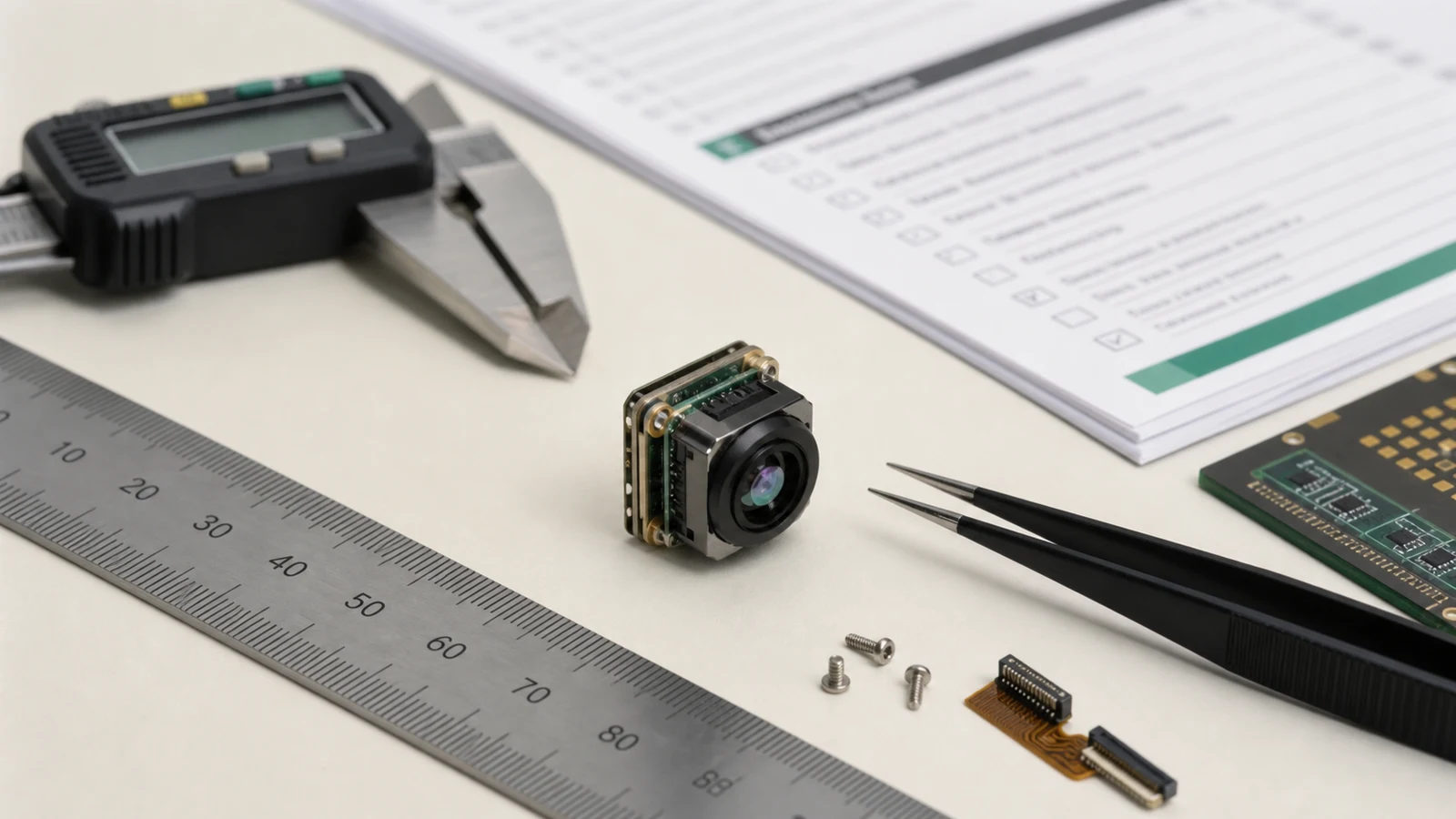
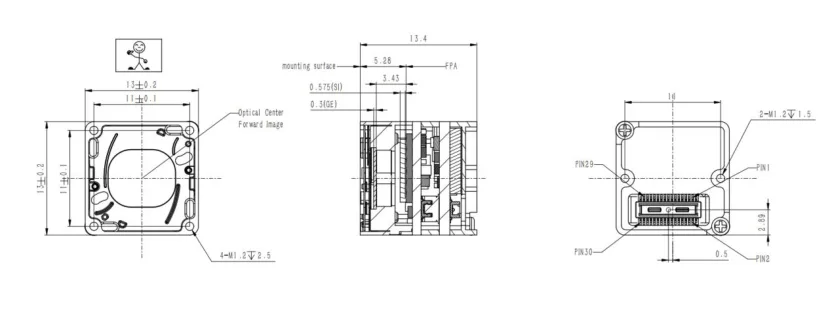
For a non-clinical project, mechanical fit is a separate engineering question. The Featured SuperMini 640 imaging-only model at 50 Hz is an independent bare-core example: 13 x 13 x 13.4 mm and <3.5 g, excluding lens, flange, and user expansion board. The following drawing is Figure 4.1 on physical page 13 of the SuperMini V1.0.0 product manual. It describes SuperMini, not the AeroMini assembly discussed later.
Selection chart: separate measurement intent before comparing modules
| Buyer wording | What it may really mean | RFQ risk | Safer CAMCUDA response |
|---|---|---|---|
| Core body temp | Internal clinical temperature | Unsupported medical claim if handled as a normal camera module. | Separate direct core-temperature measurement from skin-temperature screening; identify the validated system, intended use, confirmatory method, and regulatory responsibility. |
| Fever screening | Elevated body-temperature screening workflow | Requires controlled setup and clinical follow-up; environment affects readings. | Treat this as a health-screening system question, even at a workplace entrance; the imaging-only modules below are not presented as screening devices. |
| Skin temperature trend | Surface temperature or relative thermal pattern | May be useful for R&D but not equal to core temperature. | Specify whether calibrated surface-temperature data are required; the imaging-only configurations below do not supply calibrated temperature readings. |
| Occupancy or safety sensing | Thermal presence, heat distribution, or room condition monitoring | Wrong product if buyer expects clinical readings. | Review a non-clinical embedded LWIR imaging path; preserve any low-resolution, SPI, or strict power-budget requirement as a separate constraint. |
| Outdoor monitoring | Field visibility, equipment heat, perimeter awareness, or industrial monitoring | Body-temperature language can distract from actual application needs. | Use application, optics, interface, enclosure, and documentation criteria instead. |
This chart protects both sides. The buyer gets a more accurate answer, and the supplier avoids implying that every thermal camera module can produce a medically meaningful core-body-temperature value.
Featured product fit for a thermal camera that can measure core body temp search
CAMCUDA’s current Featured products can be relevant when the real project is embedded thermal imaging, outdoor monitoring, UAV inspection, or OEM thermal visibility. The SuperMini 640 imaging model and the AeroMini non-radiometric configuration below do not provide calibrated temperature measurements. They are non-clinical component examples, not evidence of a validated body-temperature screening system. That distinction should be visible in the RFQ, quote notes, and public content.
SuperMini 640 Imaging / 50 Hz is a compact 640 x 512 bare-core route for an OEM team that can design the required rails, connector, and host interface. AeroMini 640, selected here as the non-radiometric 9 mm model with USB + CVBS + MIPI, is a separate packaged integration route for OEM, UAV, or outdoor imagery. A project that genuinely needs a 160 x 120 class sensor, SPI, or a roughly 76–78 mW power budget still needs those constraints evaluated separately: neither 640 example establishes a match for that budget or interface. First establish whether the inquiry is health screening or a non-medical thermal-awareness project.
| Product model | SuperMini 640 — Imaging / 50 Hz; no temperature measurement |
|---|---|
| SKU reference | CC-SM640-I50 |
| Detector class | VOx uncooled LWIR focal-plane detector |
| Resolution | 640 x 512 |
| Total pixels | 327,680 (640 x 512) |
| Detector pitch | 8 μm |
| Spectral range | 8–14 μm |
| Frame rate | 50 Hz imaging-only model |
| Field of view | Lens dependent: 3.7 mm, 90.0° x 68.2°; 6.1 mm, 46.6° x 37.6°; 8.7 mm, 40.0° x 32.2°; 11 mm, 24.9° x 20.0° (H x V). Confirm the selected optical assembly. |
| Supply rails | MAIN_POWER 3.8–5.2 V plus separate +3.3 V and +1.8 V rails; this is not a single-rail bare core |
| Power consumption | ≤0.5 W typical core power at 25°C, excluding expansion board; budget the complete assembly separately |
| Host interface | 8-bit LVCMOS / BT656 and 2-lane MIPI paths; BT656 and MIPI cannot operate simultaneously. UART control uses 1.8 V logic. |
| Connector path | Hirose DF40C-30DP-0.4V(51), 30-pin; confirm mating orientation and the complete pin definition |
| Operating temperature | −40°C to +70°C for the imaging-only model |
| Product model | AeroMini 640, non-radiometric, 9 mm, USB + CVBS + MIPI; no temperature measurement |
|---|---|
| Detector | Vanadium oxide uncooled infrared focal plane detector |
| Resolution | 640 x 512 |
| Pixel pitch | 12 um |
| Spectral range | 8-14 um |
| Non-radiometric factory frame rate | 60 Hz factory default; optional 30 Hz factory configuration. Confirm delivered rate for each output and host. |
| NETD | ≤30 mK at 25°C, F/1.0 |
| Digital video | USB and MIPI paths in the selected package; confirm format, firmware, host support, and simultaneous-output limits |
| Communication interface | 16-pin board: RS232_RX/TX at pins 3/4, with signal levels not specified in that table. Separate 26-pin interface: UART0 TX/RX at pins 19/20, both 3.3 V. |
| Analog video support | CVBS in the selected package; confirm PAL/NTSC mode, board revision, and delivered output rate |
| Weight | <20 g, excluding lens and flange; request complete ordered-assembly mass |
| Dimensions | 21 x 21 x 28 mm, excluding lens and flange; request the complete 9 mm assembly drawing |
| Operating temperature | −40°C to +80°C |
Application case: clarify a warehouse-entry temperature request
In an illustrative procurement scenario, a North America distributor sends an inquiry: “Need a thermal camera that can measure core body temp for warehouse entry and outdoor shift-change checks.” A workplace setting does not make human elevated-temperature screening a non-medical monitoring task. If the supplier replies with a normal imaging-module quote, the record may imply clinical capability that the project has not established.
The practical handoff should slow down. First, define the decision. Is the system looking only for thermal presence or qualitative heat distribution, or is it trying to screen people for elevated body temperature? Keep those uses separate. For a health-screening system, qualified teams must address intended use, validation, environmental conditions, operator training, regulatory responsibilities, and appropriate confirmatory measurement. An ordinary imaging module does not answer those questions, and outdoor shift-change conditions must not be assumed suitable for screening.
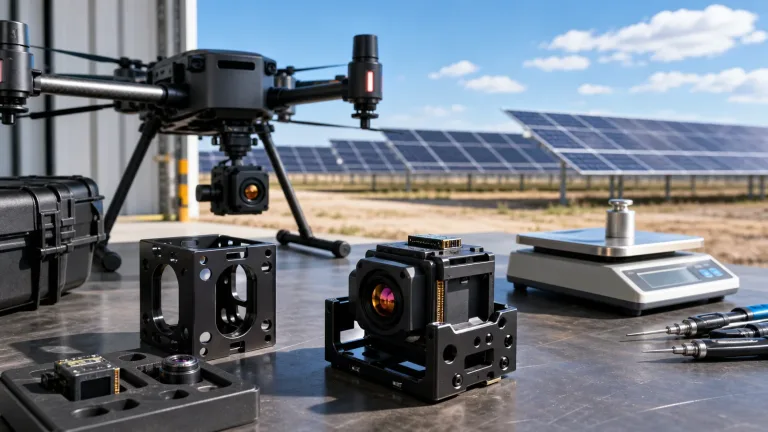
If the real requirement is non-medical outdoor monitoring, facility observation, or industrial thermal awareness, then CAMCUDA can help redirect the conversation toward application fit. The outdoor field thermal imaging application is the more relevant internal path because it covers deployment conditions, field visibility, enclosure thinking, and monitoring workflows. If the buyer’s team is also evaluating aerial patrol or inspection, the drone thermal camera application can help separate payload constraints from human-temperature wording.
This is where industry context helps. Micron’s computer vision overview describes a path from visual input through algorithms to interpretation and output. That is a useful systems analogy: a thermal module is one component in a host-device workflow. It does not establish a medical claim, a screening algorithm, or CAMCUDA host compatibility.
Interface and integration notes before any quote is compared
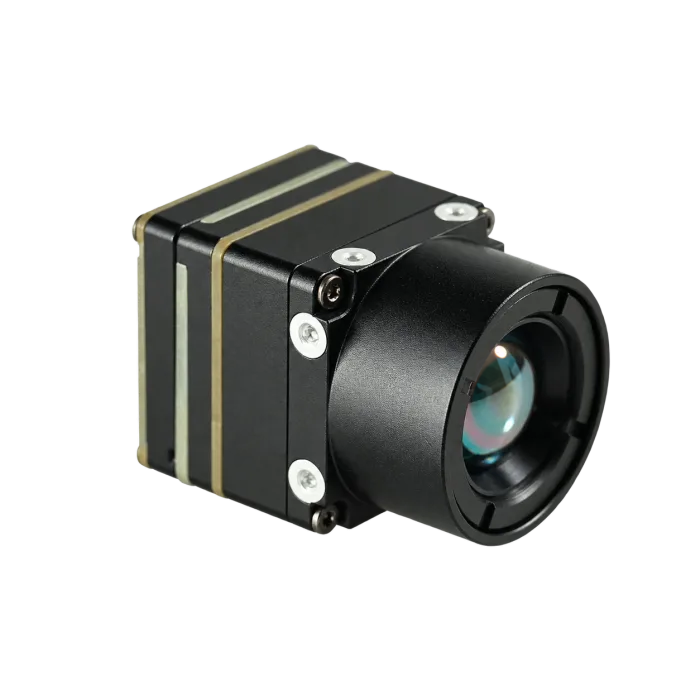
Once the buyer confirms a non-clinical OEM imaging use, the normal engineering questions return. Which host processor will read the module, and does the required resolution, bandwidth, power budget, and connector fit the design? SuperMini I50 uses its own 30-pin connection and multi-rail supply. The selected AeroMini 9 mm package includes USB + CVBS + MIPI; confirm format, delivered rate, firmware, and which outputs can operate together. USB video alone does not establish USB serial control or host compatibility.
For body-temperature-adjacent inquiries, interface wording should be especially precise. A USB, MIPI, or CVBS video path does not validate temperature measurement or screening. On AeroMini’s separate 26-pin MIPI/DVP interface, UART0 TX and RX are pins 19 and 20 at 3.3 V; do not transfer those levels to the 16-pin RS232 pins. Illustrated POWER_IN1 and POWER_IN2 pins are 5 V only. AeroMini’s <0.5 W typical consumption at 25°C is a module figure, not a complete-kit budget. For non-medical scene coverage and target sampling, the Thermal Imaging Calculator can help compare optics and distance; its geometry and DRI estimates do not measure body temperature or validate a medical system.
Buyers comparing module families can start with thermal imaging cores, thermal modules, and uncooled thermal modules. For interface planning, CAMCUDA’s USB, MIPI, CVBS, and DVP interface guide is a better continuation than a generic body-temperature search result.
For the next engineering step, use the current AeroMini datasheet, matched interface reference, AeroMini product FAQ, and official SDK and developer-resource directory. Match the files to the camera version, board, firmware, and intended host, then validate the selected capture and control path. These resource links do not establish software compatibility or clinical suitability.
Common mistakes with a thermal camera that can measure core body temp RFQ
- Writing “core body temp” when the project only needs surface thermal sensing. This can create a claim the engineering team cannot support.
- Assuming a module equals a screening system. A health-screening system needs validation for its intended use, controlled conditions, trained operators, and appropriate confirmatory measurement. Imaging-only module specifications do not establish those capabilities.
- Comparing detector resolution before intended use. A 160 x 120 class embedded sensor and a 640 x 512 video module can serve different product paths. More pixels do not establish the required power budget, interface, or medical suitability.
- Leaving interface needs vague. Specify the selected video output, delivered rate, host, control pins and signal levels, supply rails, and exact board revision.
- Skipping documentation review. For North America procurement, security monitoring, industrial monitoring, and government-adjacent projects, ask which NDAA-related and CE/RoHS documents can be supplied for the exact configuration and intended use. The buyer’s procurement and legal teams should assess their scope; these documents do not establish clinical validation or blanket program eligibility.
RFQ checklist: safer wording for body-temperature-adjacent thermal projects
| RFQ field | What to write before sending |
|---|---|
| Intended use | State whether the project concerns clinical measurement, human elevated-temperature screening, or non-medical imaging such as facility observation, outdoor visibility, or OEM device input. A workplace entrance does not change health-screening intent. |
| Measured target | Distinguish internal core temperature, skin/surface temperature, and qualitative thermal patterns, presence, or equipment heat. The imaging-only configurations here do not supply calibrated temperature readings. |
| Validation owner | Who owns protocol, calibration, reference measurement, environment control, regulatory review, and user instruction? |
| Preferred module path | For non-clinical imagery: SuperMini 640 I50 for a bare-core design, or AeroMini 640 non-radiometric 9 mm with USB + CVBS + MIPI. Evaluate any 160 x 120 class, SPI, or strict low-power requirement separately. |
| Interface | Selected video path, output format and rate, board revision, host requirements, separately verified control pins and signal levels, required rails, and matching SDK/document package. |
| Mechanical limits | Available volume, enclosure, lens window, connector route, cable bend, module weight, and operating environment. |
| Documents | Current datasheet, complete-assembly drawing, matched interface and firmware references, and applicable destination-market documents. Ask which NDAA-related and CE/RoHS documents can be supplied for buyer review; none substitutes for clinical validation. |
Use support downloads for available files, check the support FAQ for common process questions, and send unresolved application details through CAMCUDA contact/RFQ.
Clarify the measurement claim before choosing the module
If your inquiry uses the phrase “core body temp,” separate clinical measurement, elevated-temperature screening, and non-medical thermal sensing before comparing modules. CAMCUDA can help review Featured LWIR module paths, interface options, mechanical fit, and documentation needs for supported OEM, UAV, outdoor, and industrial thermal projects.
Review SuperMini 640 I50 | Review AeroMini 640 | Request engineering RFQ
FAQ: thermal camera that can measure core body temp buyer questions
Can a thermal camera directly measure core body temperature?
No. A thermal imager senses infrared radiation from surfaces in its field of view; it does not directly measure internal core temperature. Screening for elevated body temperature using skin-temperature measurements requires a system and method validated for its intended use, suitable conditions, and appropriate confirmatory measurement. The two imaging-only module configurations discussed here do not provide calibrated temperature readings.
Can CAMCUDA sell a thermal camera that can measure core body temp?
CAMCUDA supplies compact LWIR modules for OEM, UAV, outdoor, embedded, and industrial imaging. This article does not establish a CAMCUDA product as a direct core-temperature instrument or a clinically validated screening system. Clarify whether the request is for a medical or screening system, or for a non-clinical imaging component, before preparing a quote.
Is skin temperature the same as core body temperature?
No. Skin temperature can change with environmental conditions and physiology. Measurement setup also affects the reported reading. Skin temperature is not the same quantity as internal core temperature. Instrument calibration and industrial thermography specifications alone do not validate a method for clinical measurement or screening.
Which CAMCUDA Featured product fits embedded thermal sensing?
SuperMini 640 Imaging / 50 Hz is a compact Featured option for a non-clinical 640 x 512 bare-core design. It has 8 μm pixels, a 30-pin interface, MAIN_POWER plus separate 3.3 V and 1.8 V rails, and 1.8 V UART control. The 13 x 13 x 13.4 mm and <3.5 g figures exclude lens, flange, and user expansion board. It does not measure temperature and does not establish a match for a 160 x 120, SPI, or roughly 76–78 mW requirement.
When does AeroMini 640 make sense instead?
AeroMini 640 is a separate non-clinical integration option when the project needs 640 x 512 imagery with the selected non-radiometric 9 mm USB + CVBS + MIPI package. Its factory rate is 60 Hz by default with an optional 30 Hz factory configuration; confirm the delivered rate and host requirements for each output. Module dimensions are 21 x 21 x 28 mm and weight is <20 g, excluding lens and flange. It does not provide calibrated temperature measurement or establish clinical suitability.
Does CVBS help with body-temperature measurement?
CVBS is a video-output path, not a temperature-measurement or screening validation method. The selected AeroMini package includes CVBS; confirm the board, PAL/NTSC mode, and delivered rate. A video output does not turn either imaging-only configuration into a thermometer.
What documentation should a procurement team request?
Ask for the current datasheet, complete-assembly drawing, matched interface and firmware references, and configuration notes. Ask which NDAA-related statements and CE/RoHS documents can be supplied for the exact configuration, destination, and intended use, for review by the buyer’s procurement and legal teams. These documents do not establish clinical validation; any human screening claim needs its own intended-use and regulatory review.
Can thermal modules be used for facility or outdoor monitoring?
Yes, thermal modules can support non-medical monitoring such as equipment heat awareness, outdoor field visibility, industrial observation, and embedded sensing when the module, lens, interface, enclosure, and documentation fit the project.
What is the safest first RFQ sentence?
Write the intended use plainly: for example, “We need a non-medical embedded thermal imaging module for facility observation,” or “We are evaluating a human elevated-temperature screening system and need to establish whether you supply a validated system or only an imaging component.” A workplace location does not remove the distinction, and a module quote does not establish screening suitability.
Technical author: Daniel · Hardware Support; Sales contributors: Vivian, Lena and Sophie.