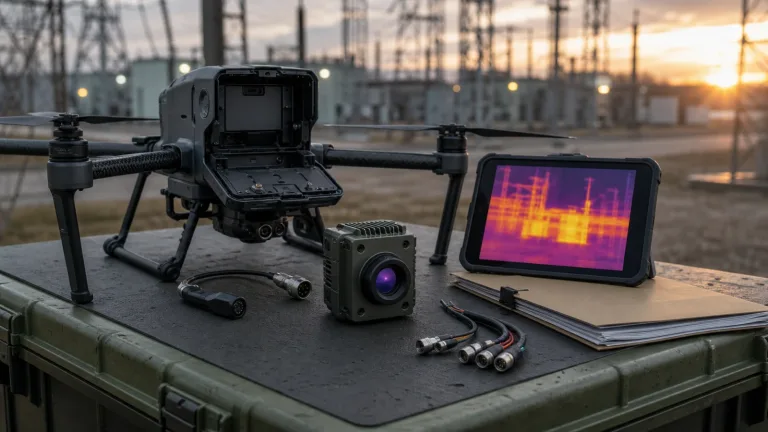
Best Thermal Cameras for OEM & UAV Integration: 640×512 LWIR Core Selection Guide
Best Thermal Cameras for OEM & UAV Integration: 640×512 LWIR Core Selection Guide
Thermal imaging system integrators, optomechanical designers, and electro-optical/infrared (EO/IR) payload engineers face a persistent engineering bottleneck when selecting the best thermal cameras for embedded deployments: balancing thermal sensitivity, spatial resolution, and optical throughput against strict Size, Weight, Power, and Cost (SWaP-C) limits. While consumer-grade thermal cores compromise on frame rates (often throttled to 9 Hz due to export controls) or rely on legacy 17 µm detector pixel pitches, modern defense, security, industrial inspection, and unmanned aerial vehicle (UAV) systems demand high-throughput 640×512 uncooled Long-Wave Infrared (LWIR) cores operating at 50 Hz with Noise Equivalent Temperature Differences (NETD) under 30 mK.
Selecting the optimal core requires an end-to-end evaluation of sensor physics, raw pixel pitch, lens aperture (F-number), optical field of view (FOV), target Detection, Recognition, and Identification (DRI) ranges via Johnson criteria, and protocol latency across MIPI CSI-2, USB UVC, and CVBS analog pipelines. This technical guide delivers an engineering-grade blueprint to navigate detector physics, optical trade-offs, interface integration, and real-world performance benchmarks using production uncooled Vanadium Oxide (VOx) OEM modules.
Table of Contents
- 👉 1. Detector Architecture: 12 µm VOx vs. Legacy Microbolometers
- 👉 2. Optical Physics & DRI Range Modeling: The Johnson Criteria
- 👉 3. Video Interfaces, Signal Latency & Edge-AI Compute Pipelines
- 👉 4. Thermal Core Engineering Benchmark: CAMCUDA FlexMini 640 vs. AeroMini 640
- 👉 5. SWaP-C Optimization & Airborne Gimbal Integration
- 👉 6. Radiometric Temperature Measurement vs. Non-Radiometric Thermal Contrast
- 👉 7. Engineering FAQ: Core Selection & Deployment Pitfalls
1. Detector Architecture: 12 µm VOx vs. Legacy Microbolometers
Let’s cut straight to the chase: the uncooled thermal imaging market has fundamentally ditched amorphous silicon (a-Si) and bulky 17 µm microbolometers in favor of high-density 12 µm uncooled Vanadium Oxide (VOx) focal plane arrays (FPAs). In the field, material physics dictates real-world performance. Vanadium oxide delivers a noticeably higher Temperature Coefficient of Resistance (TCR), typically clocking in between -2%/K and -3%/K, leaving amorphous silicon far behind. That material edge gives you a much cleaner signal-to-noise ratio (SNR), lightning-fast thermal time constants with response times dropping well below 10 ms, and solid resistance against 1/f noise across wide operating temperature envelopes.
When you drop from a 17 µm pixel pitch down to a 12 µm pixel pitch, the physical silicon footprint needed for a standard VGA 640×512 array shrinks dramatically. Do the math: on a 17 µm pitch array, your active sensing diagonal spans about 13.6 mm, with an array width of 10.88 mm and height of 8.70 mm. Shift that over to a 12 µm pitch array, and your active width drops down to 7.68 mm with a height of 6.14 mm, pulling the active diagonal down to just 9.83 mm. That is a massive 50% cut in overall focal plane surface area, and it creates immediate, tangible benefits for your entire optomechanical build.

Because your image circle is so much smaller, optical engineers can design smaller-diameter Germanium (Ge) or chalcogenide lens elements while keeping the exact same fast F-numbers and instantaneous field of view. For aerospace contractors like BAE Systems and commercial drone developers, shedding front-end glass mass is the single most effective way to keep multi-axis micro-gimbals responsive while protecting battery flight time.
Thermal sensitivity in microbolometers comes down to Noise Equivalent Temperature Difference (NETD), measured in millikelvins (mK). The lower that number, the finer the temperature delta your sensor can pick up between a target and the background clutter. Production-grade 12 µm VOx cores hit NETD numbers of ≤30 mK at F1.0 (tested at 300 K running at 50 Hz). That sensitivity is what saves the mission in low-contrast conditions, whether you are scanning open water in heavy fog, tracking heat signatures across sun-baked sand, or hunting down microscopic delamination inside composite aircraft structures during shop floor NDT inspections.
Look, native 50 Hz frame rates are non-negotiable for edge processing and dynamic aerial tracking. Export-hobbled 9 Hz cores produce massive inter-frame latency, rolling shutter artifacts, and heavy motion smear whenever a gimbal slews or a drone pulls a high-speed bank. A true 50 Hz sensor pushes fresh, uncompressed frames every 20 ms. That constant temporal feed gives your onboard vision tracking models the crisp data streams they need to keep tracking locked on fast-moving targets.
2. Optical Physics & DRI Range Modeling: The Johnson Criteria
Here’s the deal with Long-Wave Infrared (8–14 µm) performance: your system is only as capable as its front-end glass. Picking the right focal length is a game of balancing Instantaneous Field of View (IFOV), spatial target sampling, and real-world atmospheric attenuation. IFOV tells you the exact angular footprint that hits a single pixel, calculated cleanly from your detector pixel pitch (p) and your objective lens effective focal length (f):
IFOV = p / f
Take a 12 µm pixel pitch detector paired with a 9.1 mm focal length lens as an example:
IFOV = 0.012 mm / 9.1 mm = 1.318 mrad
At a 1,000-meter stand-off distance, one single pixel maps out to a ground footprint of 1.318 meters by 1.318 meters. When you bump up focal length, your IFOV tightens down, putting more pixels on target downrange at the direct expense of your overall scene FOV.
To establish baseline operational ranges you can trust, we map system performance against the classic Johnson criteria. This empirical benchmark defines the minimum resolvable line pairs (spatial cycles) across a target’s critical dimension to hit a 50% probability threshold for Detection, Recognition, or Identification:
- ⚙️ Detection (1.5 cycles / 2 pixels minimum): The operator or software spots a distinct thermal delta separating a target from background clutter.
- ⚙️ Recognition (6.0 cycles / 8 pixels minimum): The operator classifies target class (e.g., distinguishing a person from an animal, or a pickup from a semi).
- ⚙️ Identification (12.0 cycles / 16 pixels minimum): The operator discerns fine-grained tactical details (e.g., seeing handheld gear or specific vehicle model characteristics).
Below is the optical breakdown and calculated range estimates for the CAMCUDA FlexMini 640, modeled against a standard NATO human target profile (1.8 m × 0.5 m with a 0.75 m critical dimension):
| Focal Length | Field of View (H × V) | IFOV | Human Detection | Human Recognition | Human Identification |
|---|---|---|---|---|---|
| 4.9 mm | 76.2° × 64.2° | 2.45 mrad | 476.0 m | 119.0 m | 60.0 m |
| 9.1 mm | 45.8° × 37.3° | 1.31 mrad | 884.7 m | 221.2 m | 110.6 m |
| 13.0 mm | 33.0° × 26.6° | 0.92 mrad | 1,263.9 m | 316.0 m | 158.0 m |
| 19.0 mm | 22.9° × 18.4° | 0.63 mrad | 1,847.2 m | 461.8 m | 230.9 m |
| 35.0 mm | 12.5° × 10.0° | 0.34 mrad | 3,402.8 m | 850.7 m | 425.4 m |
In the shop, remember that Germanium lenses have to be precision aligned, seated, and focused at the factory to maintain thermal stability across cold snaps and hot days. Pick your focal length up front based on your operational range requirements before committing to a final mechanical payload enclosure.
3. Video Interfaces, Signal Latency & Edge-AI Compute Pipelines
Plugging a thermal camera module into an autonomous machine vision stack or an avionics suite means picking an interface that fits your compute power, latency budget, and driver ecosystem. You generally have three output options to work with: USB UVC, MIPI CSI-2, and analog CVBS.
USB Video Class (UVC): Standard USB delivers immediate, headache-free driver compatibility across Linux, Windows, macOS, ROS, and Android. Connected via USB 2.0 or Type-C headers, the core enumerates right out of the box as a standard capture device. You can stream 8-bit AGC-enhanced YUV/MJPEG video directly to a display, or pull raw 14-bit microbolometer data for onboard radiometry and custom CV processing. It is the go-to standard when working with single-board computers like the NVIDIA Jetson Orin Nano, Raspberry Pi CM4, and industrial x86 hardware where dev speed is paramount.
MIPI CSI-2 (Camera Serial Interface): When you need maximum throughput and absolute minimal latency, MIPI CSI-2 connects directly into the host processor’s hardware Image Signal Processor (ISP). Running over differential D-PHY lanes, MIPI routes raw pixel buffers with near-zero overhead, routinely keeping hardware latency below 5 ms. Eliminating the USB stack frees up valuable host CPU headroom for intense edge-AI tasks like real-time neural network detection, target tracking, and multi-spectral sensor fusion models—topics tracked closely across engineering outlets like VentureBeat AI.
CVBS Composite Analog Video: Even with high-speed digital buses everywhere, analog CVBS (PAL/NTSC) remains a dominant workhorse in FPV setups, tactical UAV feeds, and legacy pan-tilt platforms. CVBS comes straight off the core’s digital-to-analog converter (DAC) with near-zero latency (<20 ms pipeline delay), completely sidestepping frame buffering and digital compression lag. It hooks up cleanly to long-range analog transmitters and COFDM microwave links without fuss. For wiring schematics, grounding protocols, and termination advice, check out our deep-dive guide on CVBS thermal camera module analog video integration.
4. Thermal Core Engineering Benchmark: CAMCUDA FlexMini 640 vs. AeroMini 640
Selecting the right core comes down to matching your physical envelope, electrical rails, lens requirements, and data outputs against system constraints. Here is a hands-on technical breakdown of two proven uncooled 640×512 LWIR modules built for distinct operational environments.
Product 1: CAMCUDA FlexMini 640 LWIR Thermal Camera Module
The CAMCUDA FlexMini 640 is an ultra-compact OEM engine purpose-built for direct integration into industrial diagnostics gear, security fixtures, medical devices, and ground robotics. Built around a 640×512 uncooled VOx array with a 12 µm pitch, this module delivers sensitivity rated at ≤30 mK NETD and runs a native 50 Hz frame rate. Weighing just 23.1 grams without glass and drawing under 0.7 W over a wide 5–24 V DC input range, it makes mechanical and electrical integration exceptionally clean inside tight enclosures.
| Specification Parameter | Technical Value / Operational Range |
|---|---|
| Detector Type & Material | Uncooled VOx Focal-Plane Array (FPA) |
| Spatial Resolution & Pitch | 640 × 512 pixels | 12 µm pixel pitch |
| Spectral Band | 8 – 14 µm (Long-Wave Infrared) |
| Thermal Sensitivity (NETD) | ≤30 mK (@ F1.0, 300 K, 50 Hz) |
| Output Frame Rate | 50 Hz native refresh rate (PAL reference) |
| Factory-Fitted Lens Options | 4.1 mm (Extra-wide), 4.9 mm ($518.31), 9.1 mm ($423.10), 13 mm, 19 mm, 35 mm (F1.0) |
| Supported Interfaces | CVBS Analog, USB UVC, or MIPI CSI-2 |
| Connector Pin Definitions | UVC: USB-VDD, D-, D+, GND | CVBS: Rx, Tx, CVBS, GND, VCC |
| Power & Input Voltage | 5 – 24 V DC wide-range input | <0.7 W power consumption |
| Module Weight & Thermal Range | 23.1 g bare module | -20 °C to +60 °C operating envelope |
View Product Details & Pricing ➔
Product 2: CAMCUDA AeroMini 640×512 Uncooled LWIR USB Thermal Camera Core
The CAMCUDA AeroMini 640 UAV thermal imaging core is optimized specifically for drone gimbals, compact airborne payloads, and custom retrofits onto platforms like DJI industrial carriers. Built around an uncooled VOx 640×512 detector with a 12 µm pitch, the AeroMini features an integrated 3-in-1 interface board that simultaneously breaks out digital USB video, CVBS composite analog video, and serial telemetry. This lets engineers run direct, zero-lag analog feeds down to pilot goggles while streaming digital USB frames into an onboard companion computer for edge-AI processing.
| Specification Parameter | Airborne Payload Operational Range |
|---|---|
| Detector Technology | Uncooled VOx (Vanadium Oxide) Microbolometer |
| Resolution & Pitch | 640 × 512 pixels | 12 µm pixel pitch |
| Spectral Sensitivity | 8 – 14 µm Long-Wave Infrared (LWIR) |
| Available Optics Configuration | 8 non-radiometric options: 4, 7, 9, 13, 18, 25, 35, and 50 mm focal lengths |
| 3-in-1 Payload Interface | Simultaneous USB digital video, CVBS composite analog, and Serial control |
| Thermal Imaging Mode | Non-radiometric thermal contrast imaging (Radiometric versions available upon request) |
| Platform Compatibility | Custom brushless gimbals, embedded payload computers, and DJI-type UAV platforms |
| Integration Workflow | 01 Define (FOV/Envelope) ➔ 02 Select (Lens/Bus) ➔ 03 Evaluate (Sample) ➔ 04 Freeze (Production) |
View Product Details & Pricing ➔
5. SWaP-C Optimization & Airborne Gimbal Integration
Packaging an uncooled LWIR core into a stabilized drone gimbal or compact robotic pod comes down to rigorous SWaP-C management. In practice, small oversights in weight balance, harness tension, or thermal conduction can cause stabilization jitter, strain motors, or trigger thermal drift.
Mass Distribution and Center of Gravity (CoG): A core like the CAMCUDA FlexMini 640 weighs only 23.1 grams at its base, keeping rotational inertia low for pitch, roll, and yaw motors. When you mount long telephoto optics (like 19 mm, 35 mm, or 50 mm glass), dense Germanium elements pull your center of gravity forward along the optical axis. You need to adjust your mounting plate backwards to keep the assembly’s combined center of gravity aligned with the gimbal’s mechanical pivot axes. That prevents motor overheating, avoids micro-oscillations, and extends motor operational life.
Thermal Dissipation and Drift Management: Microbolometers are sensitive thermal instruments. While uncooled VOx cores use internal mechanical shutters and active Non-Uniformity Correction (NUC) algorithms to keep pixel baselines uniform, heat trapped inside a sealed pod will degrade sensor output. Drawing under 0.7 W, these modules run very cool, but in IP67-sealed enclosures, you still want thermal interface material (TIM) coupling the core’s aluminum housing directly to your payload chassis. Dissipating heat efficiently prevents focal plane thermal gradients, keeping fixed-pattern noise and drift out of your image stream during long operations.
Vibration Isolation and High-Flex Wiring: Fast brushless UAV motors and carbon props create high-frequency mechanical vibration (typically in the 100 Hz to 2 kHz band). If that vibration passes straight into your microbolometer, it can cause microphonic noise, showing up as horizontal banding or ripple artifacts in your video. Isolate your camera housing using silicone dampeners tuned to absorb high-frequency motor harmonics. Route all power, video, and data lines through high-flex, silicone-insulated wire with generous strain-relief loops. That eliminates binding, prevents gimbal motor drag, and maintains reliable signal integrity through continuous 360-degree rotations.
For engineering sample dispatch, procurement scheduling, and batch manufacturing logistics, visit our regional support directory via CAMCUDA Engineering Locations.
6. Radiometric Temperature Measurement vs. Non-Radiometric Thermal Contrast
Integrators constantly ask whether their payload really needs a radiometric core or if a non-radiometric contrast core is the right tool. Both utilize identical uncooled microbolometer sensor hardware to detect LWIR energy, but their internal FPGA pipelines and data output structures serve distinct mission profiles.
| Operational Parameter | Non-Radiometric Imaging Mode | Radiometric Measurement Mode |
|---|---|---|
| Primary Mission Focus | Target detection, situational awareness, navigation, ISR | Quantitative surface temperature measurement & analysis |
| Output Data Stream | 8-bit YUV/CVBS/RGB with dynamic AGC enhancement | 14-bit / 16-bit RAW digital temperature array per frame |
| Onboard Image Processing | Digital Detail Enhancement (DDE), CLAHE, adaptive filtering | Emissivity mapping, distance & atmospheric compensation |
| Bandwidth & Processing Load | Low (Direct plug-and-play to display and telemetry systems) | High (Requires host computation to convert RAW data to °C/°F) |
| Typical Application Profiles | Search and rescue, perimeter security, tactical FPV UAVs | Utility grid inspection, solar panel analysis, building thermography |
Non-radiometric thermal cores (such as the standard CAMCUDA AeroMini 640 and CAMCUDA FlexMini 640) are engineered to maximize target contrast, outline edge profiles, and boost scene visibility. They execute dynamic range compression, automatic gain control (AGC), and Digital Detail Enhancement (DDE) directly in their onboard FPGA pipeline. This outputs a high-contrast 8-bit stream ideal for human monitors and real-time edge-AI object classifiers tracking targets across cluttered environments:
- ✅ Immediate hardware-accelerated target recognition without host CPU overhead.
- ✅ Low-bandwidth data formats ready for standard telemetry downlinks.
- ✅ Direct, low-latency display driving over analog CVBS or standard USB UVC.
Radiometric thermal cores output absolute, calibrated surface temperature values for every single pixel in the array. Rather than compressing video into an 8-bit output, the core pushes raw 14-bit or 16-bit matrices representing radiant flux. The host computer takes this data and maps it against factory calibration curves, factoring in emissivity parameters, background reflections, ambient temperatures, and atmospheric distance. If you are building a tactical ISR or search-and-rescue payload, radiometric data creates unnecessary host processing burden and consumes extra bandwidth. Match the sensor architecture to your exact operational requirements before locking down system firmware.
7. Engineering FAQ: Core Selection & Deployment Pitfalls
Why do consumer-grade thermal cameras fail in long-range UAV and industrial inspection applications?
How do I select the right factory-fitted lens focal length for my specific operational envelope?
What are the primary differences between CVBS analog video, USB UVC, and MIPI CSI-2 interfaces in thermal integration?
📚 References & Further Reading
- Industry Standard: Advanced Electro-Optical Defense Technologies via BAE Systems
- Industry Standard: Real-Time Edge Processing & Embedded Frameworks via VentureBeat AI
- Related Guide: CVBS Thermal Camera Module Analog Video Integration & Pinout Guide
- Related Guide: CAMCUDA AeroMini 640 UAV Drone Thermal Imaging Core
- Related Guide: CAMCUDA FlexMini 640 LWIR Uncooled VOx Thermal Module
- Technical Resource: Regional Distribution & Logistics Directory via CAMCUDA Engineering Locations