IR Drone Thermal Camera Selection: Engineering Guide to OEM Cores, Resolution & Payload Integration
IR Drone Thermal Camera Selection: Engineering Guide to OEM Cores, Resolution & Payload Integration
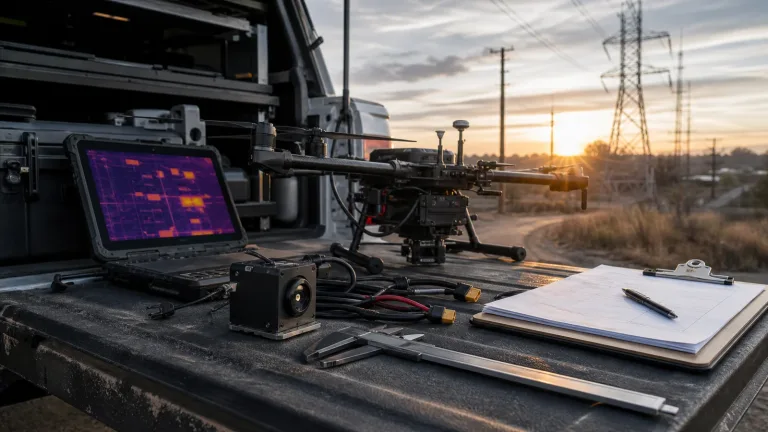
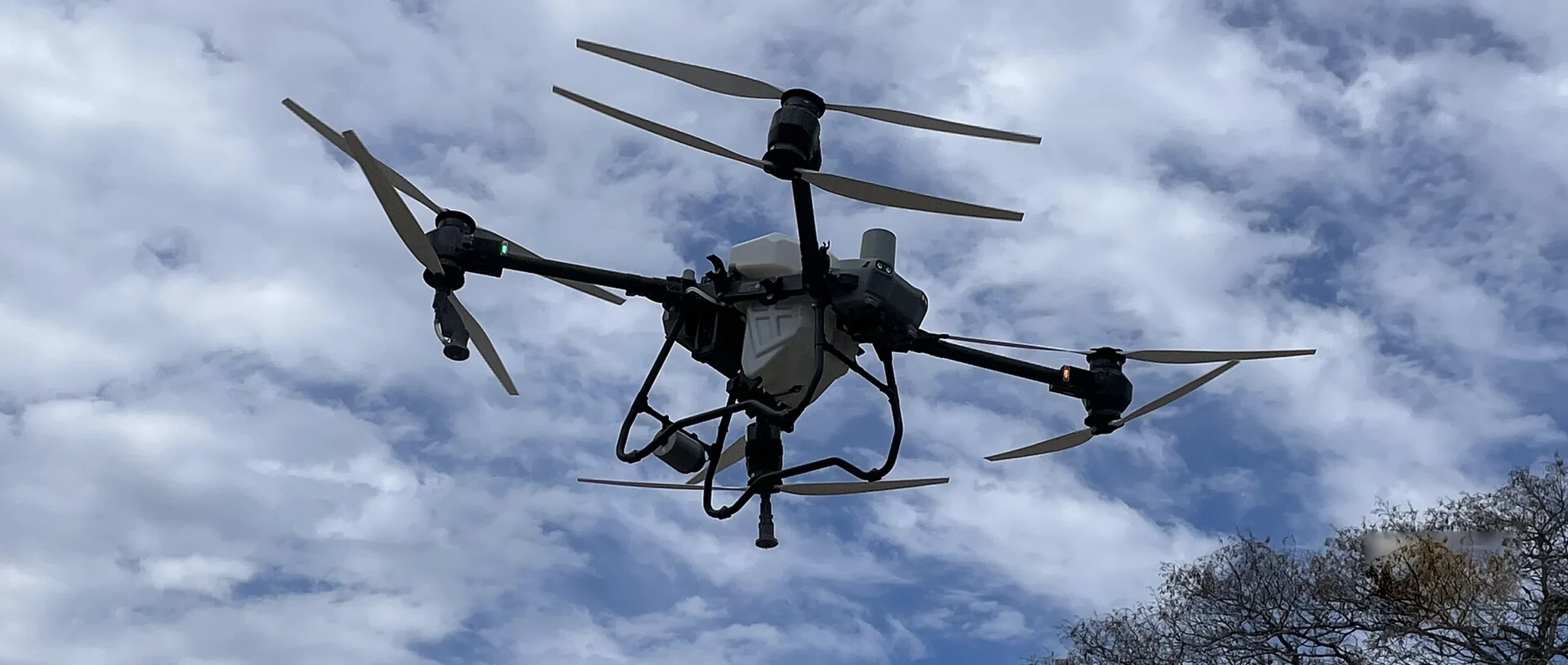
Integrating a thermal infrared imaging core onto an unmanned aerial platform isn’t just about bolting a sensor to a drone. In the shop, you quickly learn it’s a tight balancing act between optical physics, thermal sensitivity, electrical signaling, and brutal Size, Weight, Power, and Cost (SWaP-C) limitations. Modern industrial drone payloads have to pull clean radiometric and non-radiometric target data at altitude while surviving high-frequency motor vibration, volatile propwash airflow, and strictly capped onboard battery buses.
Here’s the deal: choosing between long-wave infrared (LWIR) microbolometers, specific sensor pixel pitches, optical focal lengths, and dual-sensor electro-optical/infrared (EO/IR) setups makes or breaks mission viability. Whether you are inspecting high-voltage power lines, securing industrial perimeters, monitoring structural concrete, or flying search-and-rescue grids, the wrong core will ground your project. This guide breaks down the core selection criteria for IR drone payloads—from focal plane array (FPA) physics and Johnson criteria calculations to interface protocols like MAVLink telemetry and embedded edge computing with Qualcomm AI architectures.
Table of Contents
- 👉 1. Physics of Airborne IR Imaging: Active NIR vs. Passive LWIR Cores
- 👉 2. Sensor Resolution, Pixel Pitch & Johnson Criteria Calculations
- 👉 3. SWaP-C Optimization & Gimbal Stabilization for IR Drones
- 👉 4. Telemetry, Communication Interfaces & Edge Processing
- 👉 5. Reference Field Hardware & Optical Solutions
- 👉 6. OEM Procurement, NDAA Compliance & Deployment Checklist
- 👉 7. Deep-Dive Frequently Asked Questions
1. Physics of Airborne IR Imaging: Active NIR vs. Passive LWIR Cores
When you sit down to select an infrared camera for an airborne platform, you have to separate your spectral bands clearly: Near-Infrared (NIR, 0.75–1.1 µm), Short-Wave Infrared (SWIR, 1.4–3 µm), Mid-Wave Infrared (MWIR, 3–5 µm), and Long-Wave Infrared (LWIR, 8–14 µm). We see engineers confuse active night-vision CMOS sensors with true passive thermal imaging cores all the time.
Active Near-Infrared (NIR) imaging is completely dependent on reflected photon flux. If you fly an active NIR payload at night, you must blast the scene with an onboard 850 nm or 940 nm LED or laser illuminator. While this setup lets you use standard silicon CMOS sensors to grab sharp images cheaply, it falls apart in the air. The inverse square law is brutal here: double your standoff distance, and you need four times the illumination power. On a multicopter, high-power LED arrays suck battery capacity dry, generate massive parasitic heat right inside your payload housing, and light your aircraft up like a Christmas tree to anyone with basic night vision. On top of that, NIR wavelengths get crushed by Mie scattering whenever you fly through smoke, industrial haze, or marine fog.
Passive Long-Wave Infrared (LWIR) payloads play by a completely different set of physical rules. They don’t care about reflected light. Instead, LWIR detector arrays measure direct blackbody thermal radiation emitted by physical matter according to Planck’s radiation law and the Stefan-Boltzmann law. Uncooled Vanadium Oxide (VOx) and amorphous Silicon (α-Si) microbolometer arrays detect emitted photons directly within the 8–14 µm atmospheric transmission window. Because terrestrial objects (running from -40°C to +80°C) emit energy that peaks squarely inside this band, passive thermal sensors give you high-contrast imagery in zero-lux, pitch-black environments without emitting a single photon.
Look at atmospheric penetration: LWIR wavelengths are significantly larger than the particulate diameter of standard airborne smoke, aerosols, and fine dust. That means Rayleigh and Mie scattering drop off sharply. An LWIR-equipped drone punches right through structural fires, thick wildfire smoke, industrial dust, and ground haze where visible and NIR cameras hit an absolute brick wall. In microbolometers, raw sensitivity is measured as Noise Equivalent Temperature Difference (NETD). For any serious industrial payload, demand an NETD of ≤ 40 mK (at f/1.0). That level of thermal resolution lets you spot subtle fractional-degree differentials—like water pooling beneath flat-roof membranes, overheating electrical distribution hardware, or human thermal signatures tucked under tree canopies.
For more background on matching microbolometer cores to specific platforms, check out our engineering teardown on high-resolution thermal imaging camera OEM selection.
2. Sensor Resolution, Pixel Pitch & Johnson Criteria Calculations
When you spec a thermal core for a drone—typically choosing between 256×192, 384×288, or 640×512 arrays—you are defining the maximum operational altitude Above Ground Level (AGL) where you can still detect, recognize, and identify a target. Spatial resolution comes down to the Instantaneous Field of View (IFOV) and the optical focal length of your Germanium or Chalcogenide objective lens.
The IFOV represents the angular footprint covered by a single detector pixel. The math is simple:
IFOV = p / f
Where p is the pixel pitch in millimeters (such as 12 µm, or 0.012 mm) and f is the focal length in millimeters. Shrink your pixel pitch or run a longer focal length, and you get a smaller IFOV. That puts more pixels on a target at long range, extending your operational standoff distance.
To convert this into real flight parameters, we turn to Johnson’s Criteria. This classic standard defines the 50% statistical probability threshold for resolving targets based on how many line pairs span the critical dimension:
- 🔍 Detection (1.5 line pairs / 3 pixels): The operator can tell something is there against the thermal background clutter.
- 🎯 Recognition (6.0 line pairs / 12 pixels): The operator can classify the object (distinguishing a human from a deer, or a utility van from a passenger car).
- ⚙️ Identification (12.0 line pairs / 24 pixels): The operator can verify specific details (identifying if an individual is holding equipment, or reading the structural status of a high-voltage insulator cap).
For a standard human target profile with a critical dimension Hc = 0.75 m (the geometric mean of a 1.8 m × 0.5 m profile), you calculate your maximum operational standoff distance R in meters like this:
R = (Hc × f) / (2 × N × p)
Where N is the required line pairs, f is your lens focal length in mm, and p is the sensor pixel pitch in mm.
| Sensor Resolution | Pixel Pitch (µm) | Focal Length (f) | Field of View (H × V) | Detection (1.5 lp) | Recognition (6.0 lp) | Identification (12.0 lp) |
|---|---|---|---|---|---|---|
| 256 × 192 | 12 µm | 9.1 mm | 19.6° × 14.7° | 227 m | 56 m | 28 m |
| 384 × 288 | 12 µm | 13.5 mm | 19.4° × 14.6° | 337 m | 84 m | 42 m |
| 640 × 512 | 12 µm | 19.0 mm | 22.9° × 18.4° | 475 m | 118 m | 59 m |
| 640 × 512 | 12 µm | 70.0 mm | 7.0° × 4.8° | 1,750 m | 437 m | 218 m |
Look at those numbers: jumping from an entry-level 256×192 sensor to a professional 640×512 core with a 12 µm pixel pitch completely changes your flight profile. A 640×512 core backed by a 70 mm f/1.0 telephoto lens identifies a human target at over 200 meters. That keeps your drone well outside acoustic detection profiles and gives your pilots safe clearance when operating around high-voltage utility lines or rough terrain.
3. SWaP-C Optimization & Gimbal Stabilization for IR Drones
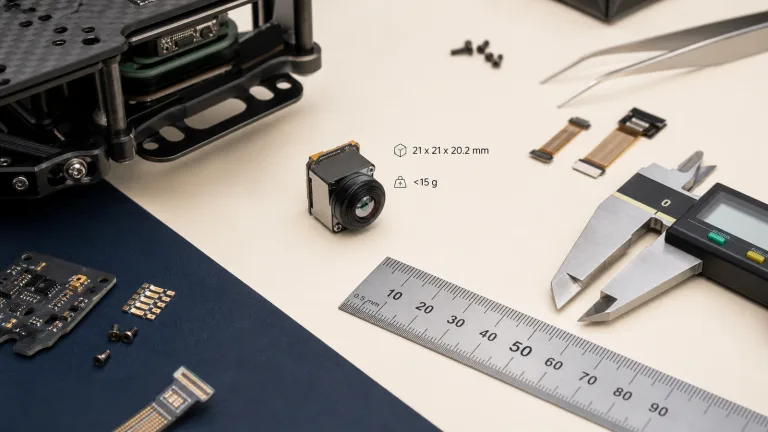
When you build an airborne thermal gimbal, you fight Size, Weight, Power, and Cost (SWaP-C) at every step. Drones operate in violent, vibrating environments. Every gram you hang on the payload nose shifts your center of gravity, forces gimbal brushless motors to work harder, and eats into your flight time.
Optics are where most thermal builds run into weight problems. Germanium is the gold standard for LWIR glass because of its high refractive index (n ≈ 4.0) and strong transmission across 8–14 µm. But Germanium is heavy—density sits at 5.323 g/cm³. Build a long focal length Germanium assembly, and your front element quickly pulls the center of gravity forward. Your pitch and roll brushless gimbal motors end up constantly drawing high holding current just to stay level. That extra draw heats up the gimbal and introduces high-frequency micro-jitter into your thermal feed.
To keep payloads light, optical engineers pair single-element aspheric Germanium lenses with precision-molded Chalcogenide glass (like Ge28Sb12Se60). Chalcogenide has a lower density (around 4.4 g/cm³) and features low thermo-optic coefficients (dn/dT). This allows passive optical athermalization across wide operating temperatures (-20°C to +50°C) without needing heavy, motorized mechanical focus compensators.
Thermal management inside the core requires careful layout. Microbolometers are uncooled, but they are not immune to thermal drift. When a drone punches through thermal inversion layers during a climb, rapid ambient shifts create temperature gradients across the sensor body, introducing raw analog signal drift. Standard cores fix this with a mechanical shutter for periodic Non-Uniformity Correction (NUC). But in the middle of an autonomous flight or tracking run, that mechanical shutter freezes the video feed for 300 to 500 milliseconds—frequently causing tracking algorithms to drop the lock.
Top-tier airborne OEM cores eliminate this issue with shutterless calibration algorithms. They monitor core temperature swings in real time using high-precision thermistors placed directly on the microbolometer die, adjusting pixel gain and offset tables dynamically on the FPGA to deliver a smooth, freeze-free video stream.
4. Telemetry, Communication Interfaces & Edge Processing
A modern IR drone payload cannot rely on legacy analog composite video feeds. Today, the thermal core operates as an intelligent edge node on the aircraft’s internal digital bus, handling uncompressed high-bitrate data, synchronizing flight telemetry, and running real-time neural network inference.
For piping digital video from the thermal core into your companion computer or carrier board, standard interfaces include 4-lane MIPI-CSI-2, parallel CMOS, or high-bandwidth USB 3.0 UVC. These links transport clean 14-bit or 16-bit uncompressed radiometric data arrays directly to your compute hardware. This ensures absolute per-pixel temperature data is preserved for analysis before downsampling into standard 8-bit color palettes (White Hot, Black Hot, or Ironbow).
Autopilot integration relies on serial buses running UART, RS-232, or Ethernet using the open MAVLink protocol. Messages like `MAVLINK_MSG_ID_CAMERA_IMAGE_CAPTURED` and `MAVLINK_MSG_ID_GIMBAL_DEVICE_ATTITUDE_STATUS` tie microsecond-accurate GPS coordinates, barometric/RTK altitude, and 3-axis gimbal angles to every captured frame. That telemetry stream is essential for automated geotagging, direct radiometric mapping, and photogrammetry workflows.
Downlinking raw 14-bit radiometric video over RF links saturates transmission bandwidth quickly. To solve this, integrators pack onboard edge AI processors powered by platforms like Qualcomm AI neural processing units. By running lightweight vision models (like YOLOv8 or MobileNet-SSD) right on the payload carrier, the drone detects anomalies locally—such as failed solar cells, hot substation bushings, or search-and-rescue targets.
Once detected, the edge processor encodes bounding boxes and target GPS coordinates as KLV (Key-Length-Value) metadata embedded straight into MISB-compliant H.264/H.265 video transport streams. This lets you broadcast lightweight operational intelligence over low-bandwidth tactical datalinks without choking your RF link.
To dive deeper into thermal hardware integration pipelines, explore the engineering deep-dives on our technical blog.
5. Reference Field Hardware & Optical Solutions
Setting up an aerial thermal platform frequently requires matching your airborne sensors with ground-based observation devices and long-range visible systems for multi-spectral verification and field ground-truthing. Here are two representative systems that showcase current electro-optical standards in real-world operations.
Ura-Y Series 640×512 Handheld Thermal Observation Binocular
The Ura-Y Series provides high-resolution thermal imaging for ground crews handling perimeter validation, site surveys, and nighttime search workflows. Built around a high-sensitivity 640×512 VOx uncooled microbolometer sensor with a 12 µm pixel pitch, this binocular delivers crisp spatial resolution and smooth 50 fps tracking for fast-moving targets.
Key Specifications & Parameters
| Sensor Type | VOx uncooled thermal sensor |
|---|---|
| Thermal Resolution | 640 × 512 |
| Pixel Pitch | 12 µm |
| Frame Rate | 50 fps |
| Optical Lens | 70 mm F1.0 |
| Field of View (FOV) | 7.0° × 4.8° |
| Weight Class | Approx. 1 kg class |
Application Alignment: Ideal for field inspection teams, perimeter monitoring, and outdoor low-light awareness where ground teams require long-focal-length 70 mm thermal optics to cross-verify airborne target coordinates.
View Product Details & Pricing ➔
CAMCUDA Era-X Long-Range Optical Rangefinder
The Era-X Series brings together high-definition visible-light optics and a long-range laser rangefinder (LRF), giving field crews precise spatial distance measurements and optical verification to complement airborne multispectral platforms.
Key Specifications & Parameters
| Sensor Type | CMOS Full Color |
|---|---|
| Sensor Resolution | 1920 × 1080 (Full HD) |
| Focal Length | 100 mm Telephoto |
| Rangefinder Measurement Scale | 50 m to 6,000 m |
| Range Accuracy | ±2 m (at distances ≤ 2,000 m) |
| Operating Temperature | -20°C to +50°C |
| Storage Temperature | -45°C to +60°C |
| Display & Media | OLED Display, Photo & Video Recording Support |
Application Alignment: Essential for outdoor engineering surveys, field inspections, and long-range situational verification where accurate target distance data (up to 6 km) is required to complement aerial electro-optical payloads.
View Product Details & Pricing ➔
6. OEM Procurement, NDAA Compliance & Deployment Checklist
Sourcing thermal imaging cores for an enterprise drone program is far more involved than buying consumer components. You have to verify regulatory compliance, interface pinouts, optical coating durability, and thermal calibration baselines. Run through this engineering checklist before locking in your OEM purchase orders:
Engineering Integration & Sourcing Gate Checklist
- ⚙️ Optical & Sensor Matching: Confirm your FPA resolution (e.g., 640×512), 12 µm pixel pitch, and focal length give you the Johnson criteria standoff distance required for your flight ceiling.
- ⚙️ Passive Athermalization: Ensure your optical housing is passively athermalized from -20°C to +50°C so your focus doesn’t drift when climbing through altitude temperature drops.
- ⚙️ Direct Digital Data Bus: Verify the core outputs raw digital video (MIPI-CSI-2, USB 3.0 UVC, or parallel CMOS) so your carrier board receives uncompressed 14-bit radiometric data.
- ⚙️ MAVLink Telemetry Stream: Confirm serial communication support for MAVLink camera and gimbal commands to enable millisecond-accurate GPS geotagging.
- ✅ Export Controls & Frame Rate: Confirm your target market supports full-frame-rate (≥ 30–50 fps) shipments or if dual-use restrictions mandate 9 Hz throttled versions under ITAR/EAR rules.
- ✅ NDAA Section 889 Compliance: Ensure all core electronics, image signal processors, and optical subcomponents comply with NDAA procurement standards. Review supply chain profiles on our global locations profile.

7. Deep-Dive Frequently Asked Questions
What is the core difference between an active near-IR camera and a passive thermal IR drone payload?
How should drone integrators evaluate thermal resolution (256×192 vs 640×512) against payload SWaP-C budgets?
Can CAMCUDA provide custom lens matching and NDAA documentation for commercial UAV integration?
📚 References & Further Reading
- Industry Standard Protocol: MAVLink Micro Air Vehicle Telemetry Protocol Documentation
- Edge Processing Technology: Qualcomm AI Neural Processing Architectures
- Related Engineering Guide: High-Resolution Thermal Imaging Camera OEM Selection Guide
- Technical Resource Hub: CAMCUDA Engineering Articles & Thermal Imaging Blog
- Supply Chain & Locations Profile: CAMCUDA Global Operations & Supply Verification Profile